Male and Female Baltimore Oriole and Their Nest

I love the nest of the Baltimore Oriole. Woven like an intricate basket, it suspends freely in the shelter of leafy branches. The winds and rain of late spring can batter it and knock it about, but it is fastened so well, it remains in place.

I love to pass under the oriole nest on a warm summer day as it sways gently in a breeze and rocks the hatchlings as they sleep. I have an image in my mind, perhaps from a passage in the book Indian Boyhood, by Charles Eastman (native name, Ohiyesa), of a papoose child-carrier swaying in a soft wind from a low branch in a tree while the mother worked nearby. I think of this image when I see the oriole nest, certain that indigenous people learned from and imitated nature.

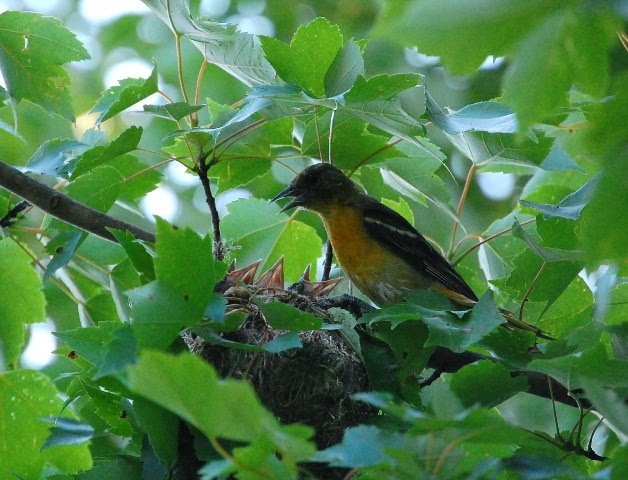
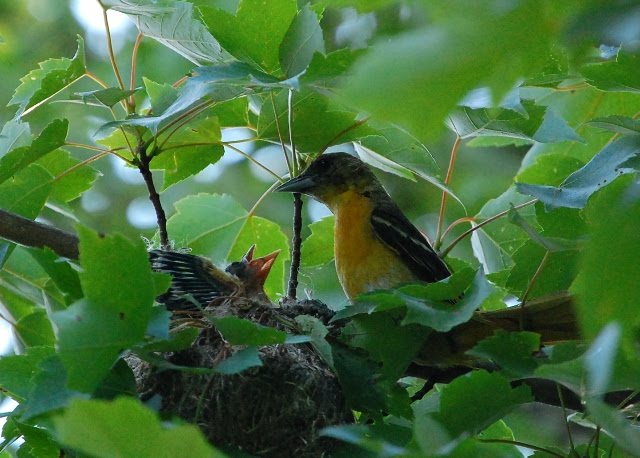
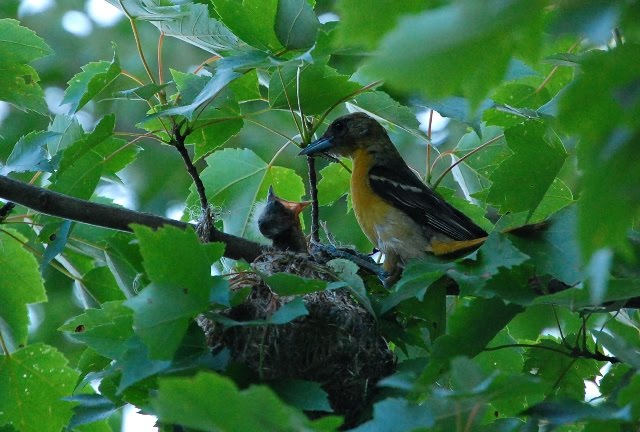
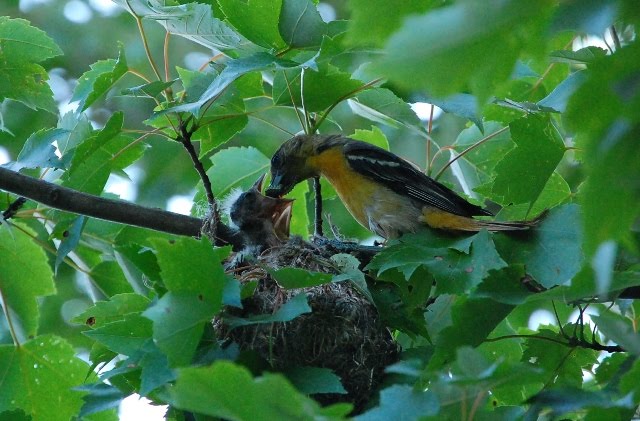
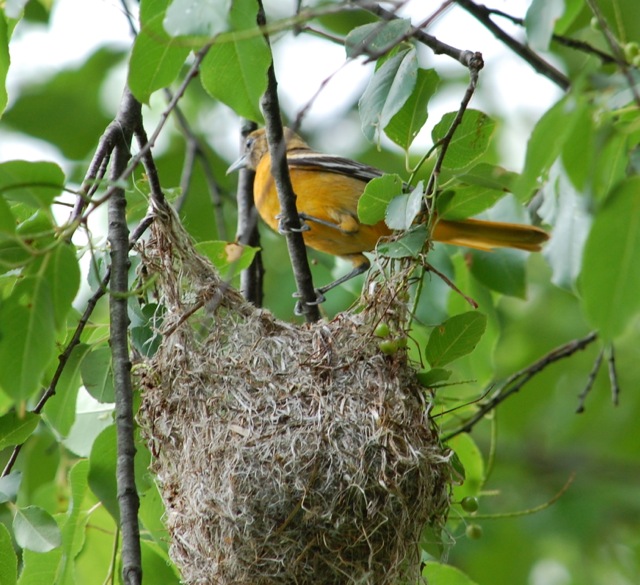
Above and below are photos I took today of the mother oriole at the nest. 
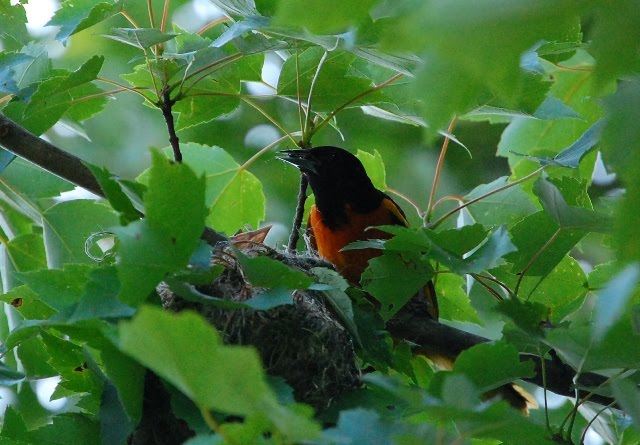
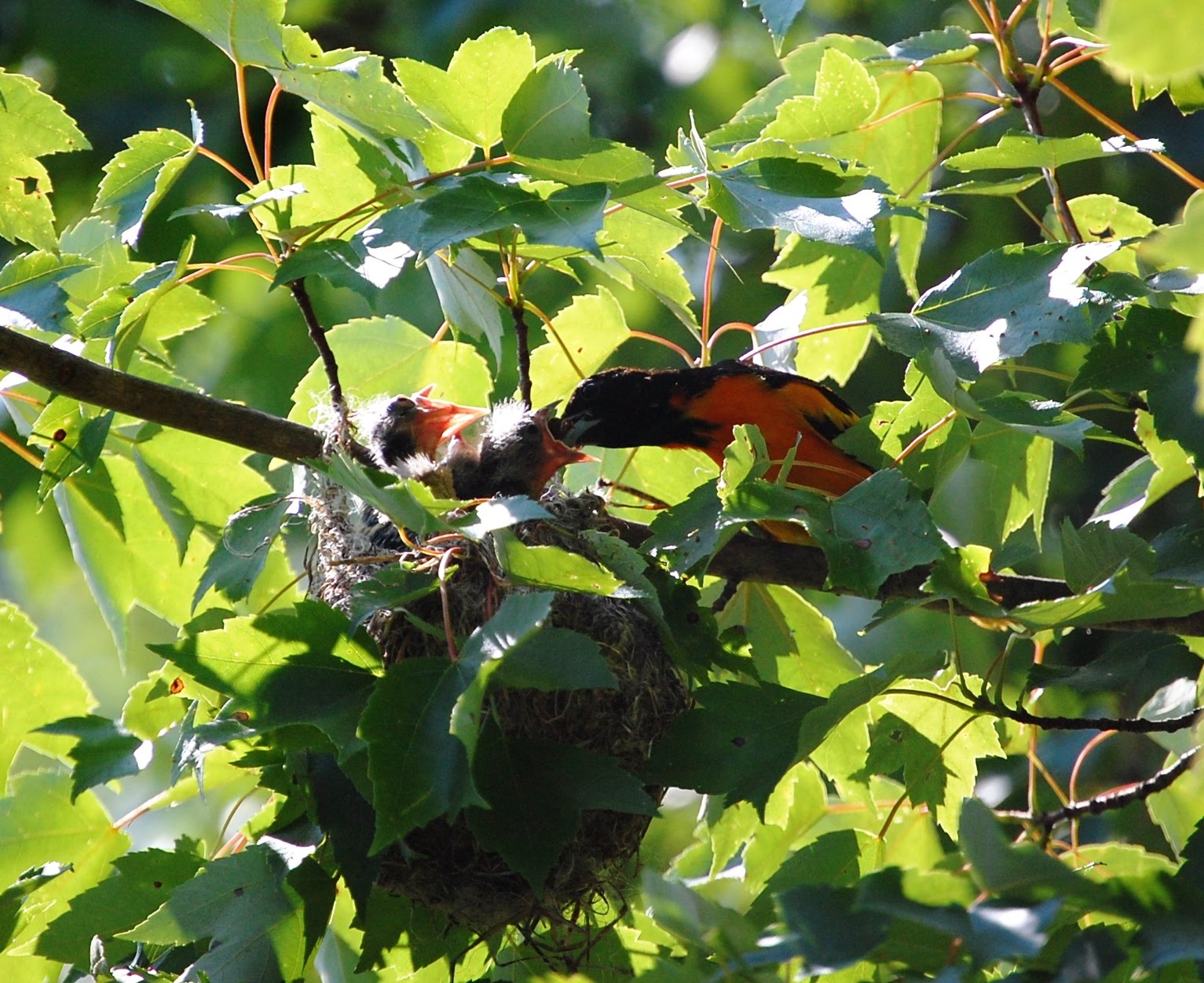
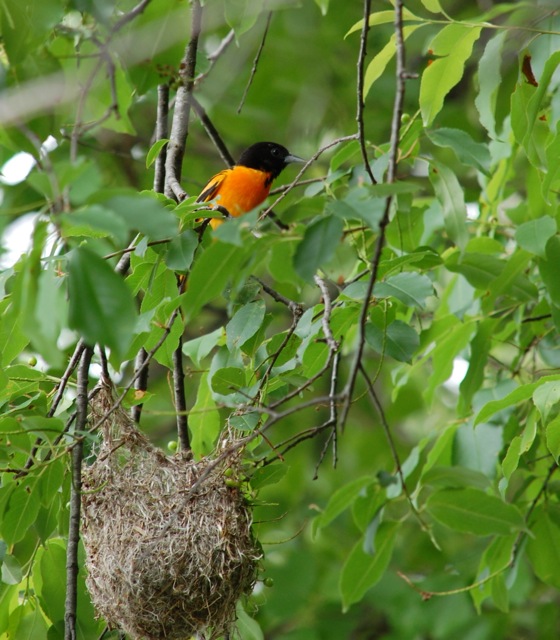
The two photos below are of the father oriole at the same nest today. Like most male birds, his colors are richer than the female.
In my observation, the male and the female are equally involved in the care of the nest and the offspring.
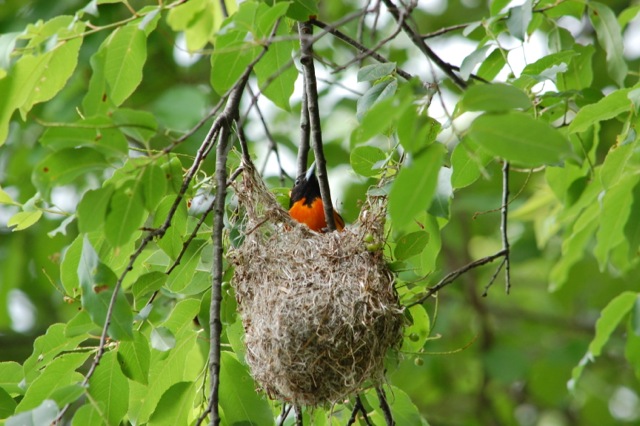
I haven’t yet seen signs of the baby birds, but I suspect they are in this nest either as eggs or tiny hatchlings! I hope to have an update and more photos in the next couple of weeks!

(Click on an image to enlarge and then scroll through all photos in this post.)

Architectural Feats

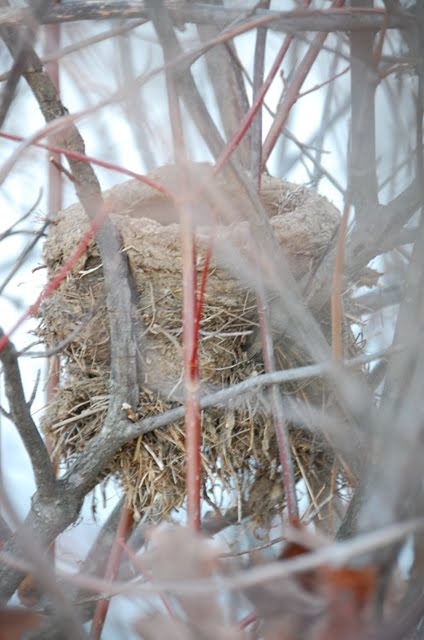
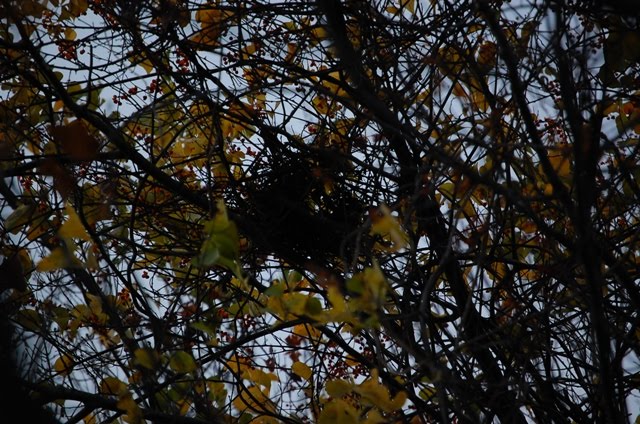
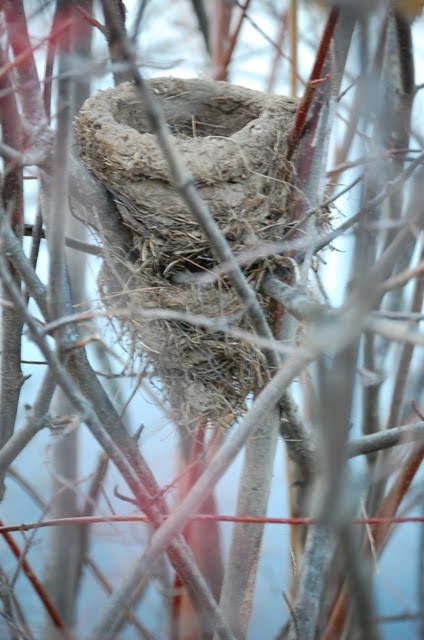
Nearly all the leaves are down now. The stark look and cold feeling of winter is coming on. Through the bare branches of the trees, birds’ nests are visible in random spots all around the pond. It is amazing to see the sizes, shapes, architectural design, and materials of the nests. Above is a photo of what I call the Guggenheim Museum (a Frank Lloyd Wright design) nest, as seen from 5th Avenue. Below is the E 89th Street side. I can’t imagine the amount of work that went into this solidly built, clay nest. About six inches (or stories) tall, it is donuts of mud stacked upon each other.
Unlike the Guggenheim Museum, an interior view of this nest is free.
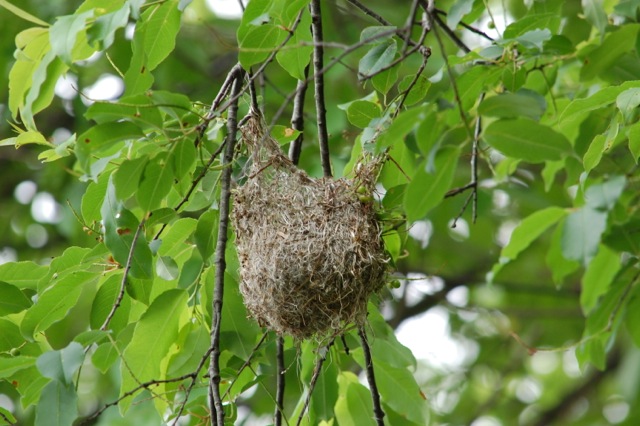
The Baltimore oriole nest from which the dear little fledgling nervously departed is below, in bare contrast to the cover of green leaves in which it was hatched and grew.

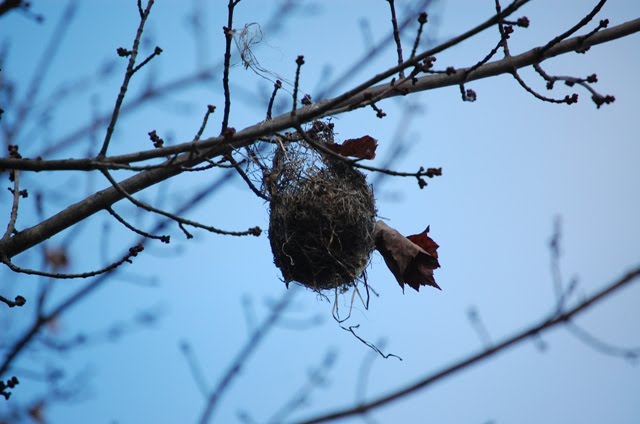
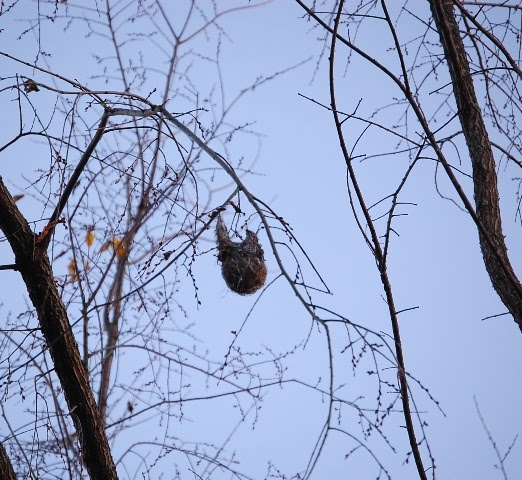
Farther along the path, at the far end of the pond, is a second oriole nest — the distinctive, dangling cradle that gives the appearance of hanging tenuously though I’ve seen it weather strong winds and pelting rain, going completely horizontal with the hatchlings inside!

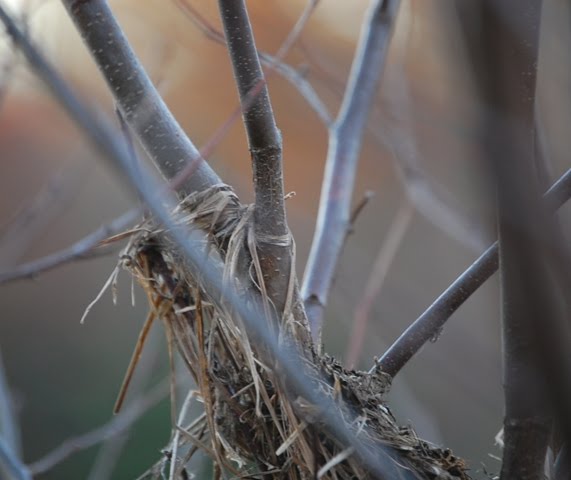
This next nest makes me question that we question the intelligence of birds. There is some serious knot tying evident in this structure, as there is in the orioles’ nests’ points-of-contact with the branches.

The close-up below shows a wrapping/tying technique.

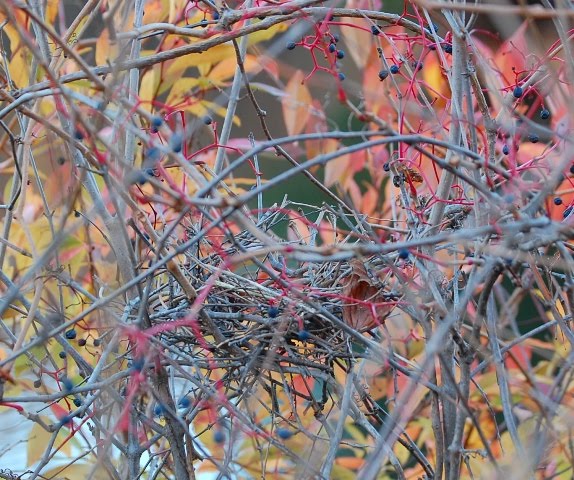
This next nest I call the “junk art” nest. It has bits of curly tendrils (from bittersweet vine, I think) as well as strips of plastic (lower left) as well as randomly sized out-shoots – for better protection, I wonder?

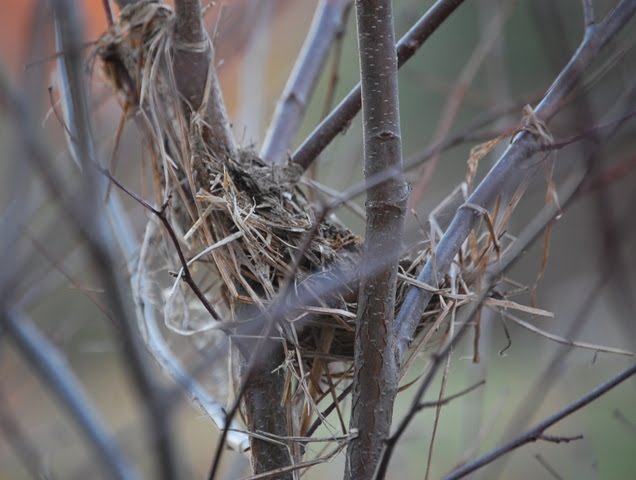
And the nest below is the “less is more” nest. I believe this is a catbird’s nest. It is located exactly where I often saw the catbird.

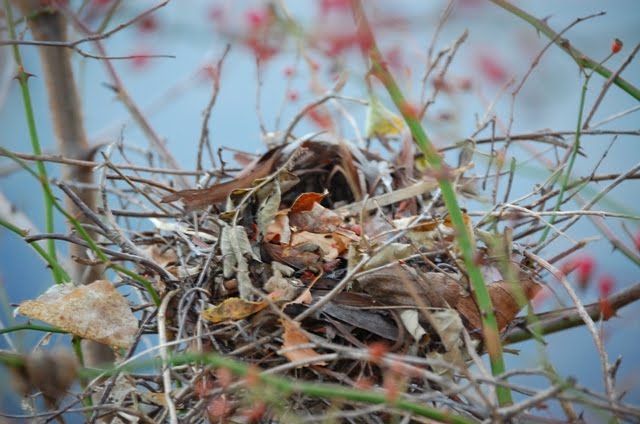
This final nest is the “debris” nest. I’m going to give the former inhabitants the benefit of the doubt and allow that an inordinate amount of leaves landed in their home…not that they were neglectful of nestwork. After all, my nest can look like this after a busy week of us not having time to pick up after ourselves.

Most of the images in this post were shot from three to four feet away because of lots and lots of branch interference. I contemplate the “thought” that went into picking the perfectly sheltered location of each of these nests. And I think of the parent birds determining on which branches to fasten the structures – for maximum stability through wind and rain, and maximum shelter from other preying animals. And I think about how they are fastened to the branches.

To my mind, instinct is two dimensional and reactive by nature. These nests are three dimensional and required an intelligence that I propose is something a bit more than instinct, if somewhat shy of actual intelligence.

The Baltimore Oriole Nesting

I’ve spent many hours during the last month taking pictures of two Baltimore Oriole nests. I’ve monitored the behaviors of the mother, the father, and the babies. I’ve learned a little and speculated a lot. And my psyche has been tweaked.

I look at the image above and I don’t know if the look in the mother’s eye is dumb instinct or a multi-tasking intelligence that hunts, feeds, protects, monitors, instructs, and prepares her hatchlings for their world.
I watch the fathers, not a dead-beat dad to be found, hustling to and from the nest, sharing equal responsibility to feed and care for the young.

There are times the mother sounds a trill for two to three minutes before she approaches the nest. The young stay perfectly still, no tell-tale jiggle of the nest giving away their whereabouts.

Then, another call from her or the father and all babes pop up, and make a racket as they open their hungry beaks and vie for the treats the parent has lined up in his or her beak. I can’t tell yet the pecking order – who gets fed first – the strongest, or the weakest, the loudest or the quietest.

There is a system or a favoritism or a readiness factor, that causes some one-on-one attention. In the image above, why is this little one the only one to be indulged with the mother’s attention? Is this a lesson or a feeding?

Perhaps it’s my imagination, but the young seem to display more enthusiasm when their father arrives to feed them. Perhaps he brings them sweeter treats while the mother keeps their food nutritious.

In the photo above, the little ones wings are seen, showing that the time for leaving the nest is coming soon. I have come to see this week that survival is hardly guaranteed. This photo was taken sometime in the last two days. This evening, one of the fledglings from this nest lay dead on the ground, while a baby Robin lies dead in the flowerbed outside my front door.

Such care is given to baby birds. During prime feeding season (which seems to go on for two weeks for the Baltimore Oriole based on my observation this June), the mother and father frequent the nest with food every six to ten minutes. Sometimes both parents arrive, back to back.
My grandmother’s mother left her and her father when she was seven. My grandmother, a bird lover, would observe the behavior I describe here, and her whole life long would ask, “Even a mother bird returns to the nest. Why did my mother never come back for me?”
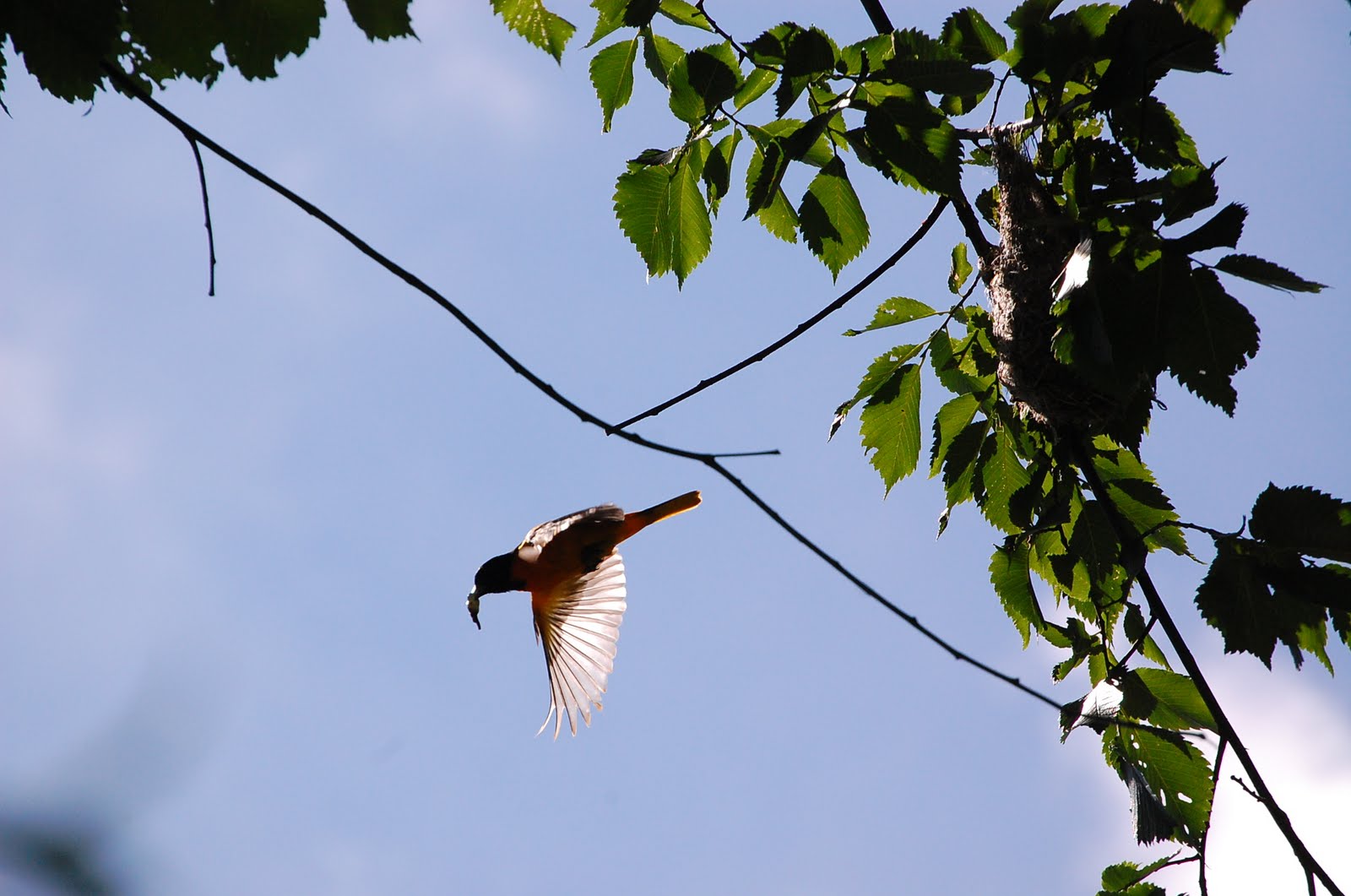
Parenting is busy work, tiring work, non-stop work. I puzzled for two weeks wondering why I often saw a male leave the nest with something in his beak – as is evident in the photo above, as the bird flies away from the nest which hangs in the upper right of the photo. A neighbor tells me that the father is removing droppings from the nest.

Nature is harsh. My affection for the little loud mouth that first brought my attention to the nest from which the images in this post were taken, is very likely the little dead bird that lay lifeless on the ground at my feet today. Was it not ready for the world? Did it not quite have its wings? Did it simply fall out too soon – a fall caused by it own over-exuberance when the parents arrived? Or did a predator take it from the nest and drop it as the parents came to its rescue?

Thoughts of life and death, beauty, fragility, hostility, love, attentiveness – fill my mind.