Barn Swallow Re-do

Last year I wrote a similar post about barn swallows. In fact, the photos here are much the same – and likewise are taken about 200 feet from the far end of the pond where cables run along and above a street.
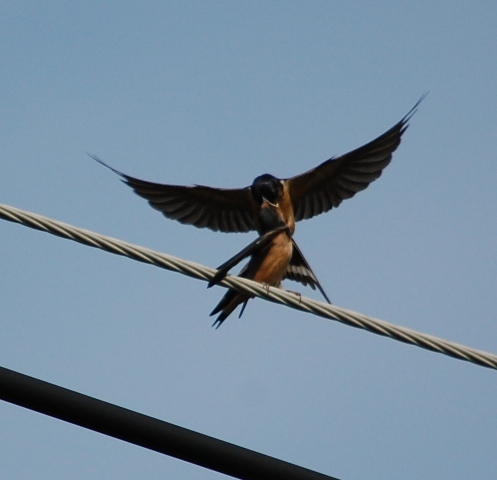
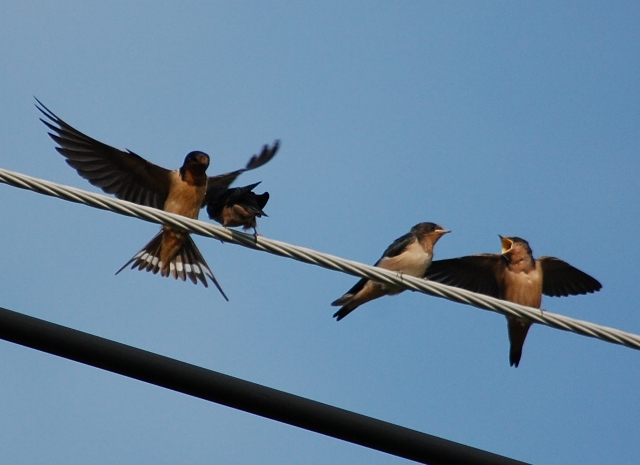
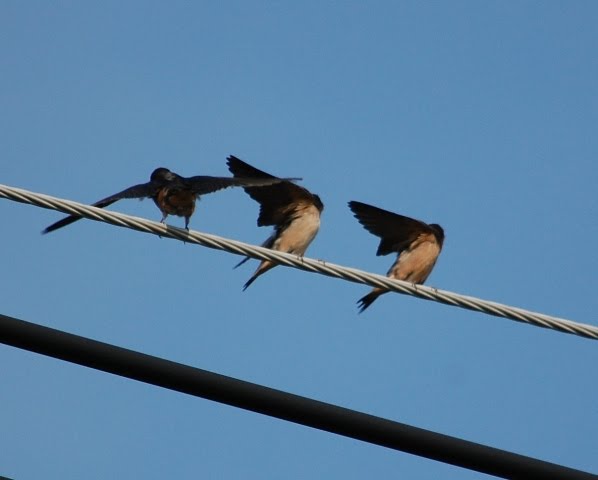
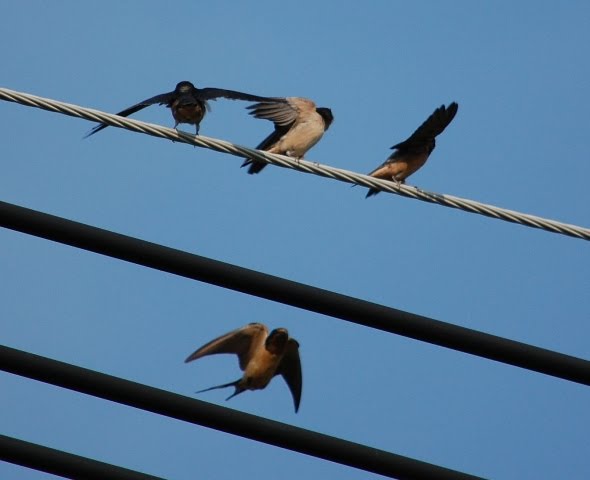
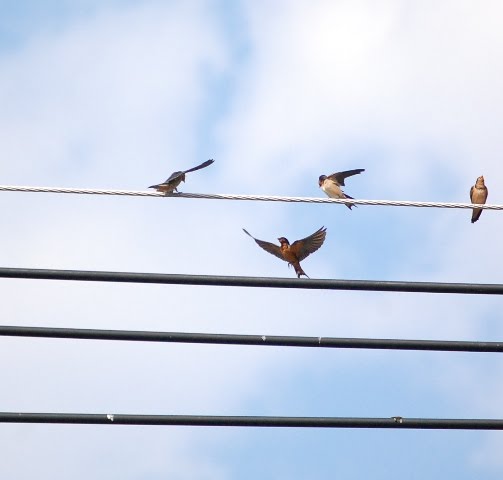
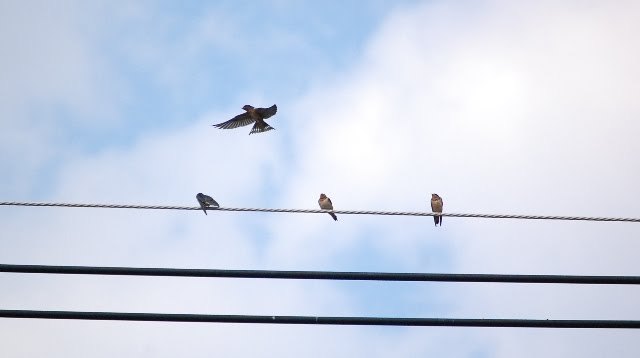
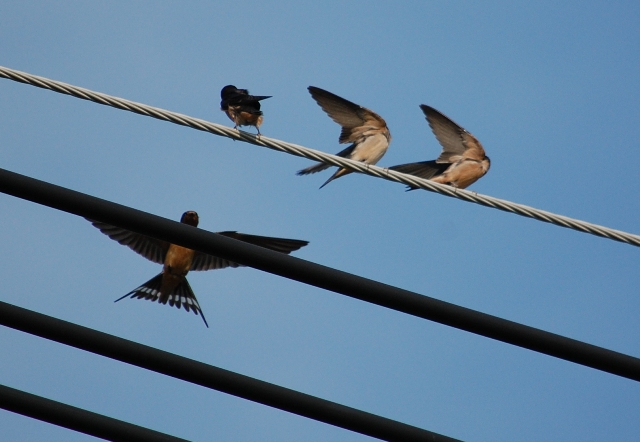
As I took these photos, over the course of an hour, about eleven fledglings were lined up and huddled at various points along a 60 foot stretch of wire. Without any signal I could discern, a small group of four or five would simultaneously launch from the line and confidently fly off, returning ten or fifteen minutes later. The reason for the groupings or their knowledge of when to take off (or the others knowing not to) remains a mystery to me.
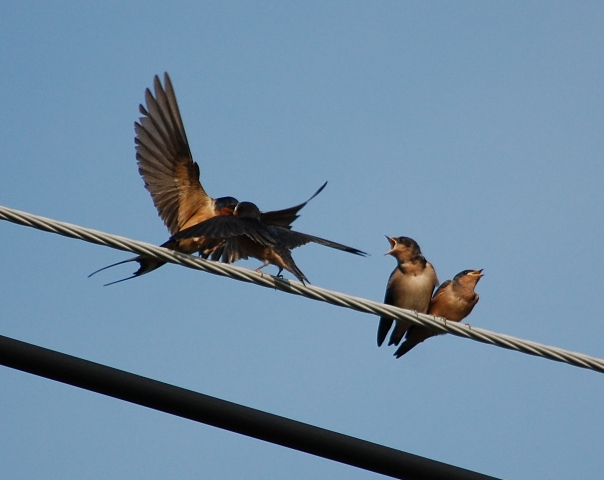
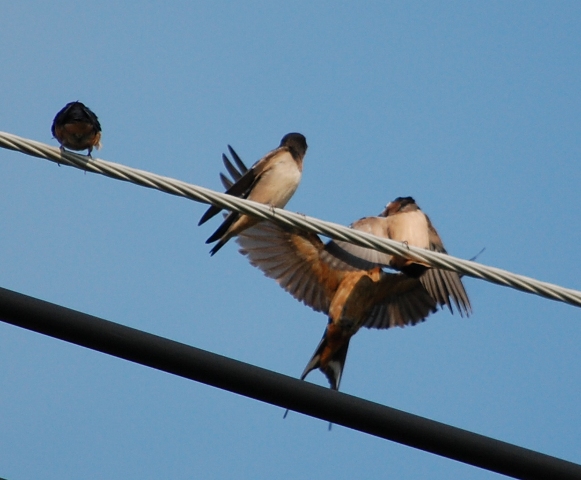
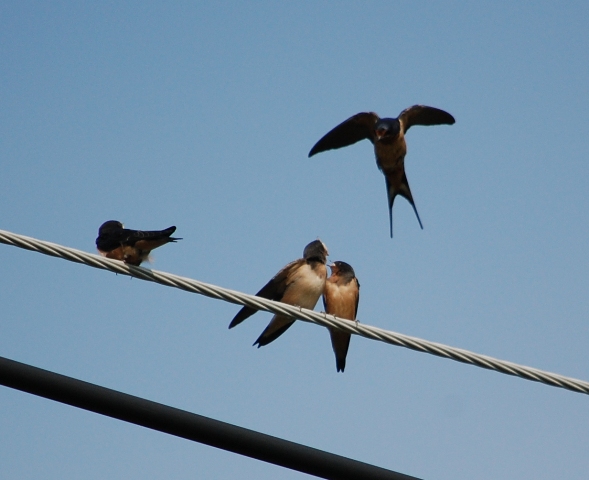
That the camera can freeze these fractions of seconds of feeding time is remarkable. The parent birds are going at a good clip, and their “stop” in mid air to feed can’t be more than a quarter of a second.
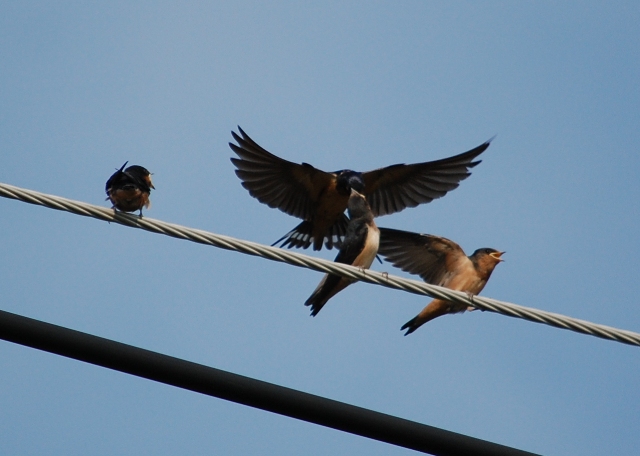
There is an elegance I see in these images – at the confluence of time and space and motion, when the wings of the adult gracefully hold the air that keeps it aloft and the fledgling strains to present its beak with eagerness and trust.
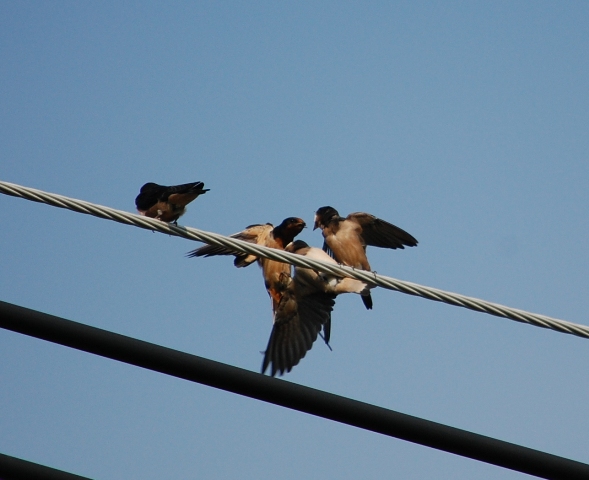
All young should have such faithful, strong and committed parents as I’ve seen birds present.
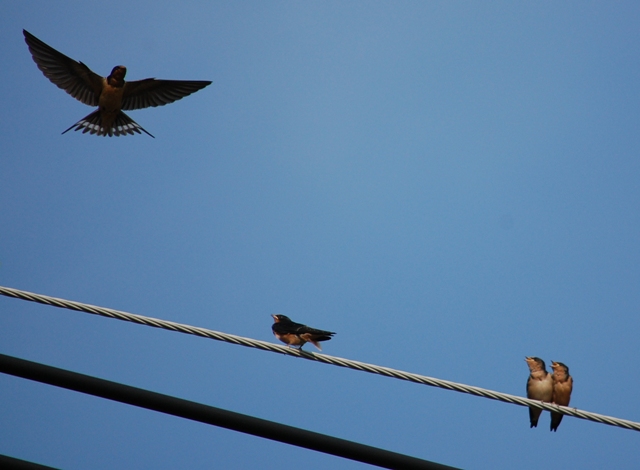
If you click on the image below to enlarge it, you’ll see that lunch for this fledgling is a dragonfly.
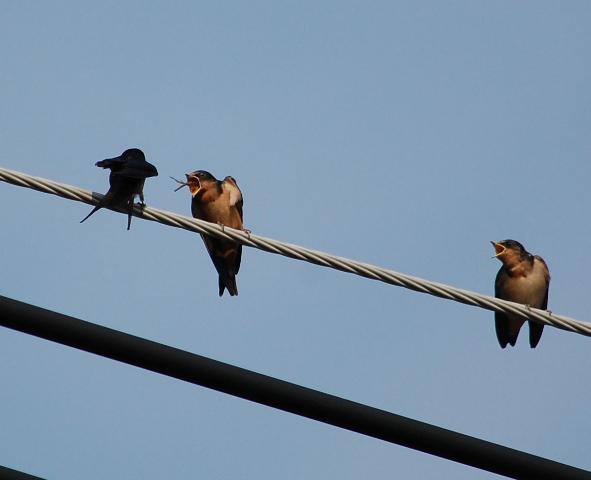
And below, see the young bird’s difficulty with the mouthful of food.


Though an hour of taking these photos may seem a long time holding the camera and aiming it over my head, the truth is the little birds help me out. They sit perfectly contently between feeding passes by the parent, which might be every ten minutes or so. But long before I know from where a parent will come, the fledglings go into a frenzy of wing flapping and raucous call, as something makes them aware the parent is about to arrive. That’s when I raise the camera, which is pre-focused on the birds on the wire, and start shooting. Though I see it, the action through the lens is too quick for my mind to sort out. So, a few seconds later, when all has quieted I review the shots and hope they will be as good as they seem to be on my small viewing screen on the camera when I download them to my computer. Here are shots of the frenzy, though they don’t do justice to the true action.
Barn Swallow’s Time of the Season

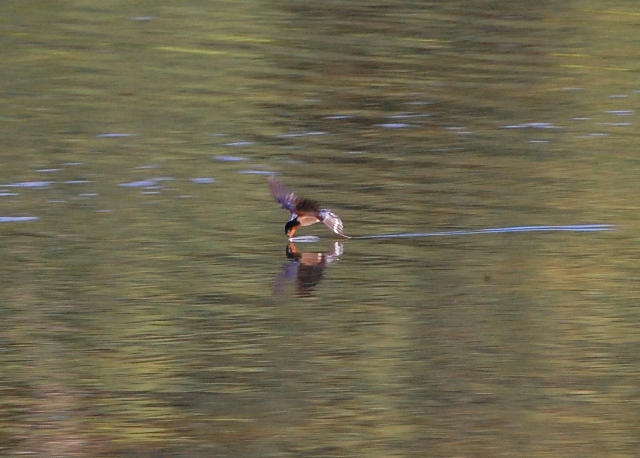
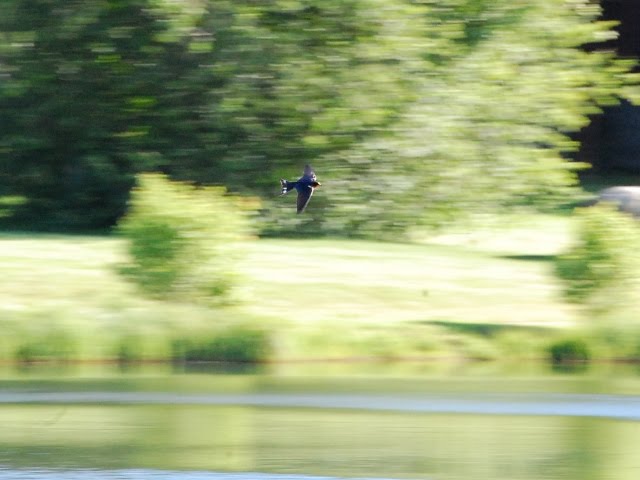
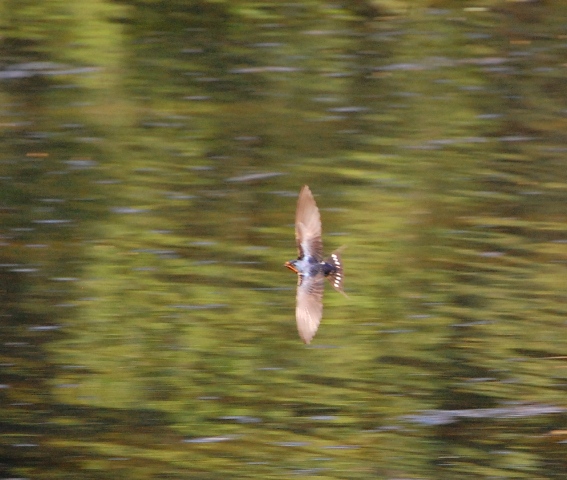
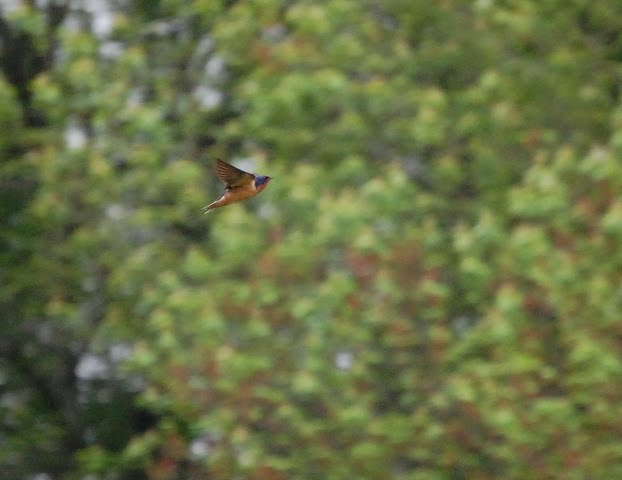
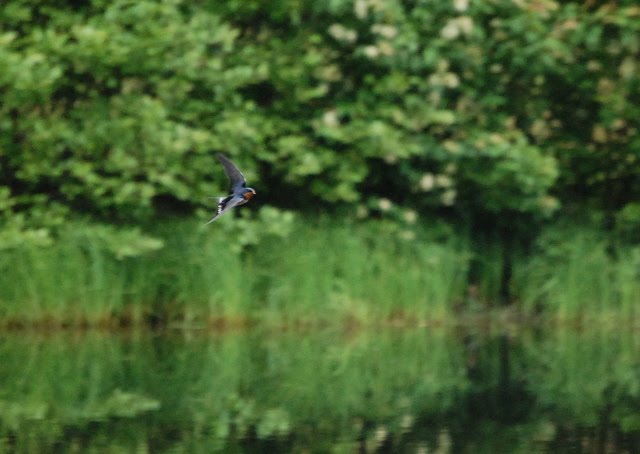
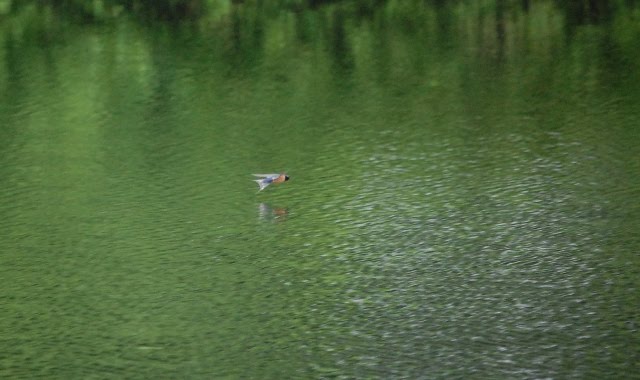
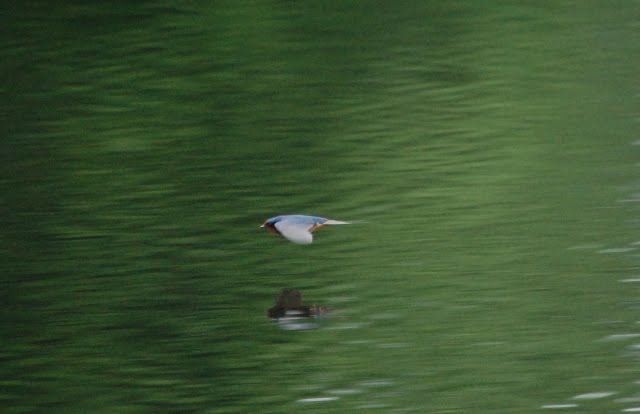
In the photo above, a barn swallow plucks from the surface of the water a tasty bug treat. Please click on the image and have a good look at it. (Use your back arrow to return to the post.) See the drag of the corner of the tail, for a couple of feet, as this bird dips its beak and skims the water’s surface as it flies at a ridiculously fast pace. The speed at which this bird constantly flies is hinted at in the image below.

This post is a mix of photos from the second week of June last year and yesterday.

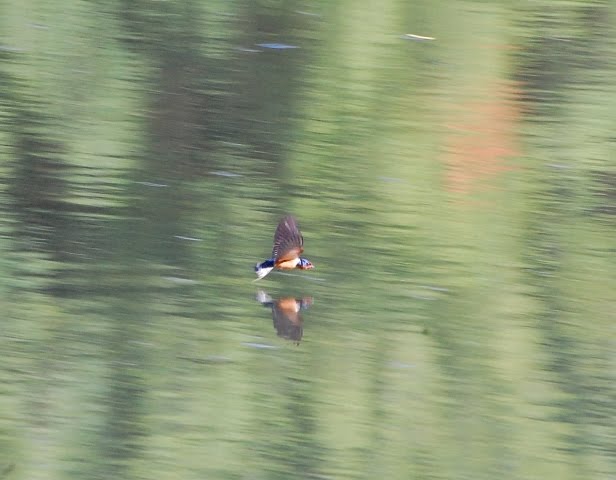
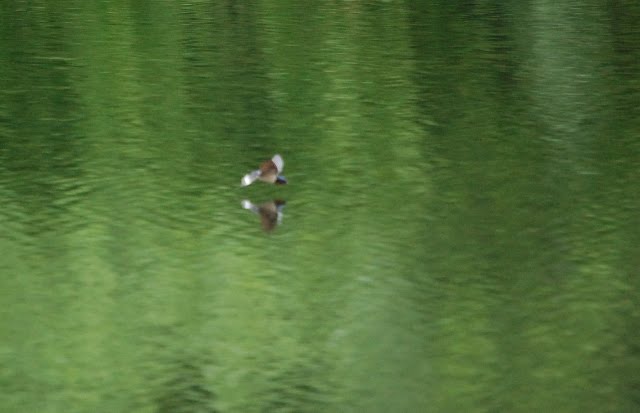
I love when the bird’s reflection is caught on the water’s surface. I’m not conscious of this in real time as the bird’s flying too fast for me to process it. So, it’s something I can appreciate through the digital image when I’m back at my computer.

The photo below is of the water’s surface as I took yesterday’s pictures. It shows the banquet of bugs that I believe the swallow is dipping for at its leisure – hardly a difficult hunt.In a recent conversation with photographer Frank Winters, without using exact quotes he told me a bit about Henri Cartier-Bresson‘s thought that we get too hung up on perfect focus in photography. With that idea in mind, I share some photos here of the barn swallow that are a bit fuzzy around the edges! But I hope this gives you a sense of the speed of this bird.

Birds on a Wire

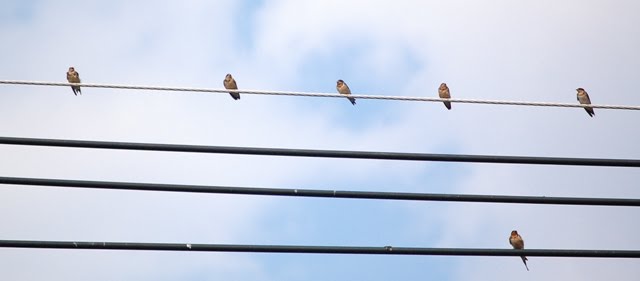
Today, I saw many birds on a wire that runs along the street that’s about two hundred feet from the far end of the pond. I thought it was a small flock passing through town.
But as I watched and took photos, I began to see and hear familiar sounds. I had thought the season of nesting and baby birds had ended. But as I watched this line-up on the wire I began to realize they were all fledglings. And the parents were busily feeding them still. It wasn’t till I was home and able to view the photos on my computer that I could identify them as Barn Swallows.
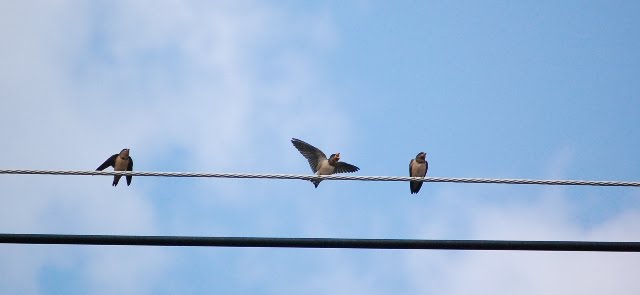
Above, a hungry young is vying for attention. And below, parents fly in, ready to position themselves for feedings.

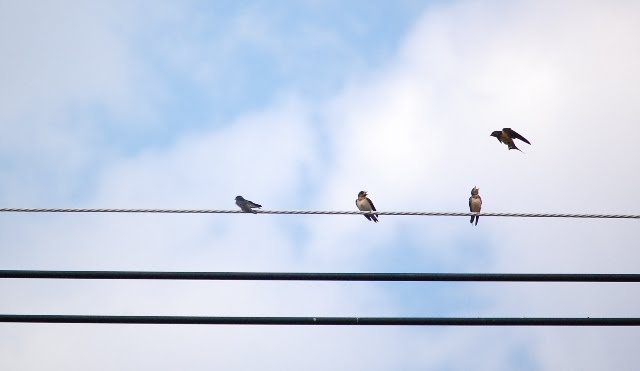
I can’t determine how the parent decides which bird gets the food. Below, two of the young show their hunger with beaks open.
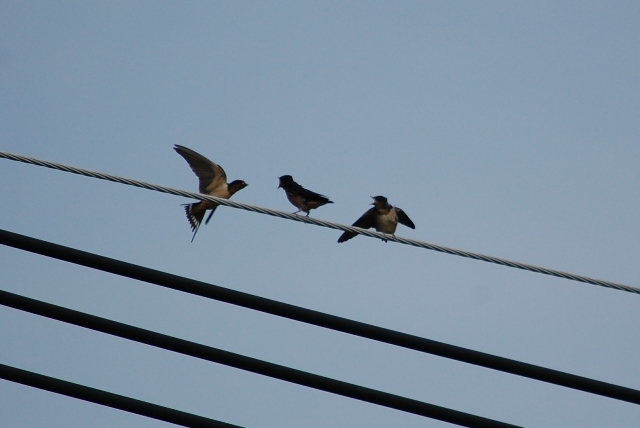
At one point, about four of the birds flew off with one of the adults (image below.) Four others remained on the wire. I have no idea how young birds know who is to go for a trial flight and who is to stay put. But I do know that there is a system of behaviors – sound and motion signals – that dictates these activities, and it’s the parent who makes the call, so to speak.
What you won’t see is how this scene ended. In the blink of an eye, the final four birds abruptly and simultaneously flew from the wire – without the accompaniment of a parent. I know – not only from what I’d seen already from these birds, but from observing the Red-winged Blackbird – that a parent escorts a group of young.
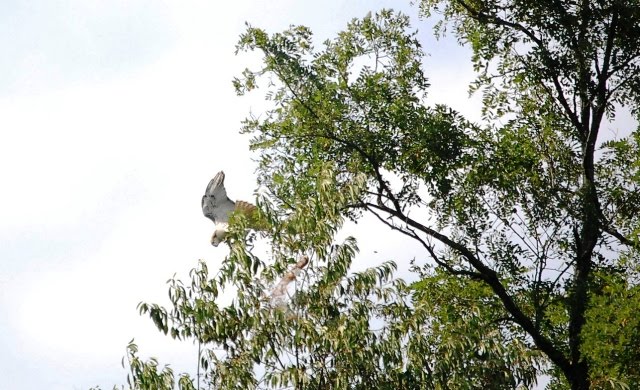
I was puzzled by this sudden and unexpected flight. So surprised in fact, that I brought the camera down from my eye, and audibly said, “What?” I was really puzzled. I found myself looking around – for the birds, or for meaning in their departure. About forty feet to my left, was the frightening answer. A Red-tailed Hawk was swooping in, having just come over the treeline. I was stunned. It was not more than thirty feet from where the birds had been. By the time I got my camera back up to my eye and was focusing, it had turned back and was just dropping behind the trees, as you can see in this zoomed-in grainy image. The predatory bird is just to the left of the treeline, midway down the image.
It was a treat to upload these images and to see the detail of the activities that had occurred in less than five minutes time.