
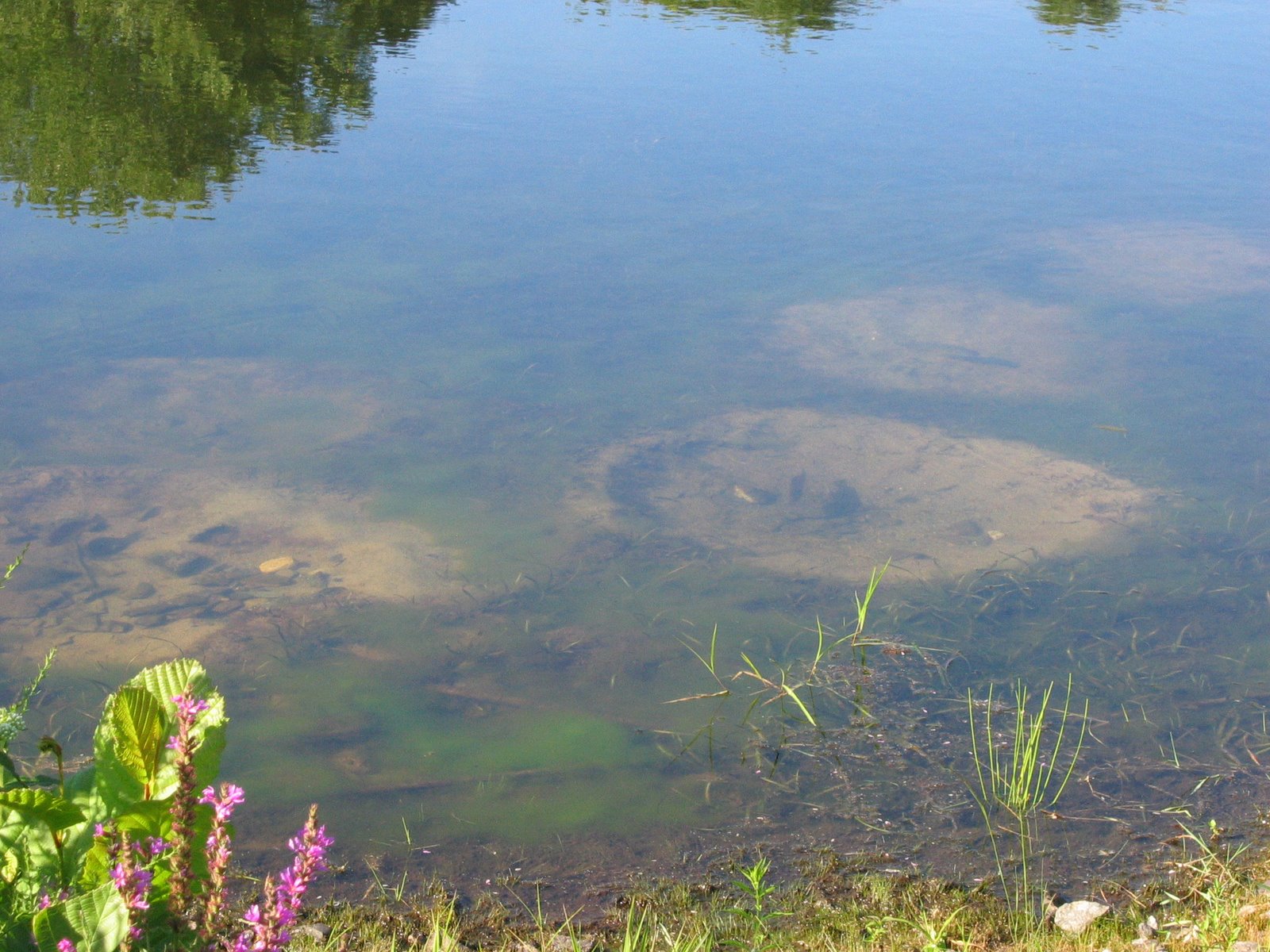
 With the arrival of spring, the action at the pond took off like a rocket. In time, I’ll be writing about a beaver, a blue heron, jumbo sized goldfish, jumbo sized turtles, jumping fish, big bugs, little bugs, bats and birds. But now, let’s get that crater theory put to rest (see Craters, Part One in the July archives).
Early one evening I was walking the dog around the pond. For the second time in a week, I came upon a fisherman. I suppose if I’m talking about the life around the pond, I should mention the occasional person I meet along the pathway. Although I’m not terribly outgoing, I think it’s impolite to simply walk by someone, if you are the only two people present. So, when I come across a person on the path, I make an effort to say something socially polite. In that vein, when I met the fisherman, I mustered up a brilliant, “How’s the fishing?” And, he politely said, “Fine.” I’m not sure who spoke next, as I could detect he was about as comfortable as I with this chit-chat. In any event, at one point he said, “you should try it,” meaning, fishing. I said, “I would but….it’s…the cootie factor.” He laughed, and said, “I know what you mean. I’m wearing my waders and boots because I hate ticks!” And, sure enough, as I took in his garb, I realized he was in a rubber barrel essentially, a comical over-dressed ensemble for our little pond. For me, the cootie factor is touching the worms, touching the fish, and not washing my hands thoroughly, with anti-bacterial soap, after each contact.
Off I went with the dog, but as I passed the fisherman on the return, I said something about the craters. In mentioning them, I know I was testing my theory about them being the effects of a spring fed pond. He looked puzzled when I said ‘craters,’ so I gestured toward one. He smiled and said, “You mean the nests?” I said, “The what?” as ‘nests’ just didn’t fit anywhere in the word lexicon of my theory. He said, “Yeah, the sunfish nests. The fish makes a nest. If you watch closely, you might see a fish tending to one, clearing the sand and small debris.”
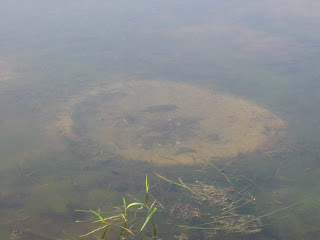
Once over the startling realization my theory was dead wrong, I began to love what these crater/nests were – little fish homes! And, as the earth warmed up, sure enough, fish by the scores could be seen in the pond, and hovering above each nest, I often would see a fish suspended and still. They swim in and around their nests, but just one occupies the water over the nest. When swimming about the banks of the pond, frequently they seem to be in pairs. I don’t dare speculate toward another theory…but, whenever I see a two-some, swimming in sync, I do wonder about their mating habits.
I’m often tempted to go to Wikipedia and research what I see. But, then I think I might just spoil the fun of simply observing. There will be time later, after a four season watch, to do all the studying I want, if I want.


 SilverLining