
 Bit by bit we are learning more and more about how fragile the Earth is, despite its enormous size in relation to anything that inhabits it. Twice recently I’ve been reminded of this in ways that are quite dissimilar.
Two weeks ago, I spent eight days at a writers’ retreat at Wellspring House. Preston and Ann Browning operate this wonderful place and, as I left at the end of my stay, Preston gave me a copy of his essay, “Struggling for the Soul of One’s Country: American Pathologies and the Response of Faith“. It’s a writing that is so well done, so truthful, so unnerving, that I invite you to do yourself (and the generations that follow) a favor, and stop to read it now. You will be enlightened, no doubt, about the tenuousness of our planet.
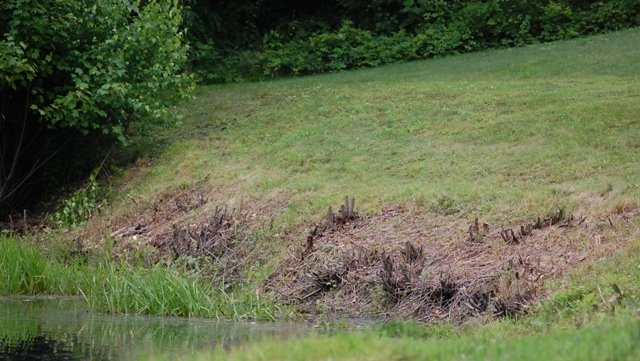
When I returned home and unpacked, of course I was anxious to walk around the pond after a week’s absence. To my dismay, over a fifth of the pond’s bordering shrubs had been cut to the ground. I cried. It was utterly disorienting. Stacked neatly in two large piles were the wilting brances, berries just ripening, dying. 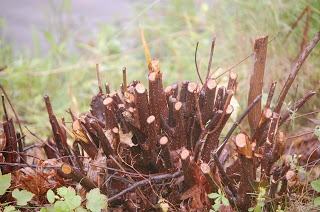 Along one side of the pond, I measured a 77 pace stretch (approximately 230 feet long) that had been razed, except for four blueberry bushes. At one end of the pond two thirds of a section of shrub had been cleared, exposing more than half a bed of reeds in which a Great Blue Heron often takes cover.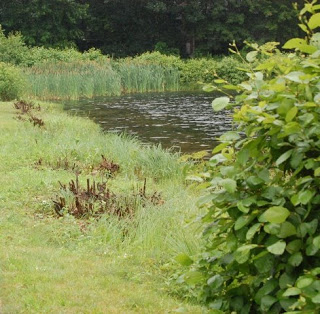
Along one side of the pond, I measured a 77 pace stretch (approximately 230 feet long) that had been razed, except for four blueberry bushes. At one end of the pond two thirds of a section of shrub had been cleared, exposing more than half a bed of reeds in which a Great Blue Heron often takes cover. I live in a condo complex where there is abundant and beautiful common space, the pond included. I asked a neighbor if she knew why this growth had been cleared. Her thought was that those who had lived here since the complex was first built 20 years ago wanted to see the pond as they had when they first bought their property. Apparently, from their windows they had been able to see the water’s surface. I had to respect this thought, though I wondered how these neighbors could have gone ahead and made this change without consultating all owners – including those of us who bought our homes when the pond had verdant shores.
My greatest concern is to the ecosystem that exists at the pond. In one act, to remove at least a fifth of the growth, I imagine to be a shock to the system. Visual esthetics aside, at this point in time, there existed a balance, a dependency, of one life to another.
I could support trimming, or clearing, thoughtfully spaced and done in a manner that is mindful of the habitat. But the imprudent leveling of tracts of shoreline shrub is upsetting to me as I am certain it is upsetting to the balance of nature at the pond. And it makes me wonder how Earth will survive if the current dominant species, at the grass roots level (literally), is not more knowledgeable and respectful of its treatment of all forms of life on the planet.
Again, I invite you to read the paper by Preston Browning. The people of this planet, especially those of the nations of greatest means, can no longer treat its host (or each other and other life forms) with self-serving disregard.

 SilverLining