A Cornucopia of Activity

I ended my walk at the pond today feeling like a news editor trying to pick the lead story of the day. Three laps around the pond yielded a host of images and tons of excitement. Unlike an editor, I’m going to present the occurrences as they came about.

It started with a nice still shot of a lily – which just happened to have the littlest busy bee within its petals. (Click on the photo above to enlarge it and spy the bee. Use your back arrow to return to the post.)

A quarter of the way into my first lap, I met up with a neighbor who enjoys fishing. He’d had a successful afternoon, returning all his catches to their water home. He graciously entertained me with no hint of resenting my interruption to the peace of his hobby. In fact, he narrated his fishing as he cast several times and brought in two fish in the twenty or so minutes I stood by him with camera ready. Through his talk, I learned a good deal about fishing at this pond and fishing in general. Here is his first catch, caught digitally.

I should say that this fisherman removes the barbs from his hooks to minimize the injury to the fish. This ten inch striped bass (correct?) seemed a bit dazed but otherwise a-okay as it was returned to the water.

With this little eight incher, the fisherman showed me how healthy the fish of the pond are this year. How beautiful! It, too, was happy to return to the water.

An interesting interlude occurred just as I was about to move along from the fishing. The black snake I wrote about yesterday appeared at the feet of the fisherman. Whatever doubt he’d had about my earlier description of it, was solidly debunked. It was as big as I had described and as dark as I’d described and without markings. He tells me it’s a ‘Black Snake’ – that’s the name of it.

Just a couple of days ago I wrote about the Red-winged Blackbird. Rounding a corner I came upon a flock of them. If you enlarge this photo (by clicking on it) you’ll see the fleck of red on some of the wings. (Scrolling down through two posts, you’ll see much better detail.)

My apologies ahead of time if you’ve seen enough of the Heron. But, the one at the pond today was huge. In fact, as the fisherman saw it take off he exclaimed, “The wing-span must be five feet!”

Next up….more babies! This time they are chicks! They are the offspring of the bird I couldn’t identify in yesterday’s post, which is, says the fisherman, a Mallard. I watched a pair of Mallards all through the early spring, and the ‘she’ did not have this tuft on her head. Nor do any of the pictures I find in my resources. But, perhaps she goes through changes in a season, or after the birth of her brood. Here they are – five little ducklings – all with Mama’s Cleopatra eyes!!!


For comparison, here is a picture of a pair of Mallards from the early spring. The female is on the right.

These presentations of the pond happened over the course of two laps. Since I’d not yet achieved the cardiovascular benefit of a good walk, I took one more quick lap. Half way around, as if to be sure my tenderness toward the turtle were not displaced, this one paddled languidly by. Its shell is about twelve inches. (Click on the photo for better detail.)

It was a great day at the pond.

A Banner Day


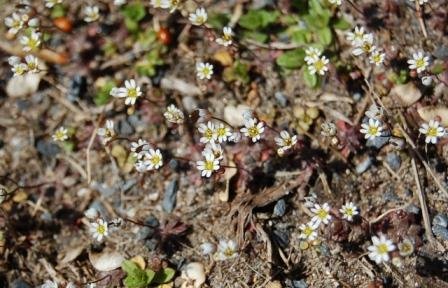
Today reminded me why I so love the pond! As I walked the path, I could see tiny white blossoms, growing barely half an inch above the ground, quivering in a gentle breeze. They have emerged through a layer of scraggly remains of last year’s grass and debris. Their delicate composition belies what they have endured to present their beauty today. Amazingly too, bees hovered over them. (All photos in this article require seeing enlarged. Click on the photo – then, use the back arrow to return to the post.)

Also, as the temp was a bit above 50 degrees today, more than the bees hovered in the air. I remember last year, ghost-like white flying things, filling the air, in clusters. Today, I saw the first swarm of them at an area where the sun’s heat particularly warmed the path.

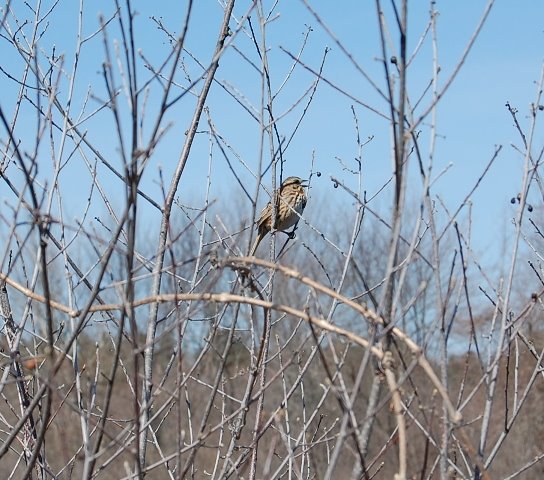
The bird pictured here allowed me to stand just three feet from it as it trilled its song, while I snap this picture.

.

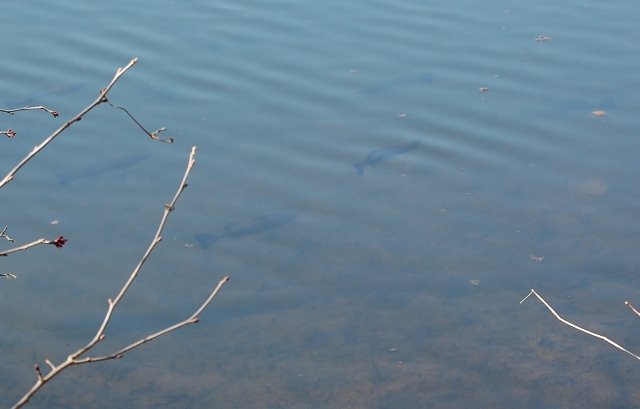
Schools of fish swam in languid motion at the deep end of the pond, taking my mind back to last summer, when this scene was commonplace throughout the pond.

This time last year, I enjoyed watching a beaver’s strong swim and listening to the crack of its tail in the frigid water of early spring, as it warned its friends of my presence. The beaver was the size of a not too small dog. Its waddle up onto the shore of the pond’s island reminded me of the motion a seal makes to maneuver onto land.

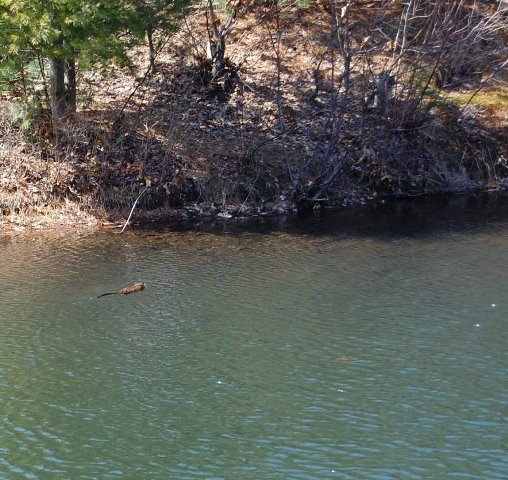
In the last two weeks, I’ve watched a little furry thing cut through the water, leaving the sweetest wake in its path. I’ve been assuming that it’s a beaver pup. But, today as I took its picture, I could hear a silent expression of ‘muskrat’ in my mind. And, now I’m not sure what it is that I’m seeing. It’s a fraction of the size of the beaver. And, while it drags a long tail, I can’t see if it’s the paddle shape of a beaver’s.

It is busy as a beaver! It makes the same circuit time after time. Exiting from a little cave in the island, at the water line, it cuts through the water to an exact point at which it dives. It remains underwater for two or three minutes, resurfaces, and hurries back to the cave. I think it has a strand of thick grass in its mouth as it surfaces from the water’s depth.

If what it carries in its mouth is food or supplies for nesting, I would think it’s a parent animal, tending to its family. And, something about its look today made me question whether or not it’s a beaver. Here’s the best photo I was able to shoot today. Be sure to enlarge it for clarity.

I’ve not mentioned turtles yet this season, but you can be sure that I’m eager to spy one and ever watchful.

Craters, Part One

The winter was mild. Infrequently was the pond covered with either ice or snow. It was early in this season that I became aware of numerous craters on the floor of the pond. They varied in diameter from approximately 14 to 30 inches. At first I was puzzled by them. But, assembling all my knowledge about natural pools (of which there is scarce quantity), I settled with pride and contentment on my conclusion that the origin of these markings in the terrain were the effects of natural springs. My pond was ‘spring fed.’ I’d heard that phrase somewhere in my past and I was comfortable with that characteristic assumption about the pond. I went so far as to decide that this meant my pond was old and it was healthy. With the naivety of a true amateur scientist, I built my conclusion into a visual image of pure cool water seeping up from layers beneath the Earth’s crust, and springing forth with such eager force as to push the surface silt into neat little circles.

With that mystery solved, I had pleasant walks around the pond as often as I could. My theory of what lay beneath the water was only reinforced when ice finally formed. With the commonness of the craters below, black patches, with dark tentacles reaching away from them, littered the frozen surface. With my continued ignorance leading my thoughts, I was sure these were places where the ice was not as well frozen, due to the water’s motion from the springs below.


It would be some months before the real cause of the craters would be explained to me by a reliable source, a fisherman.
(This I will share with you in ‘Craters, Part Two’, a few postings from now.)