
Late last night, just before midnight, I took the dog for one more walk. Actually, I think I was taking myself for one more walk. I’m finding that after the severity of this past winter, I’m loving being outdoors at all times of the new spring days. With nearly no moon-light to interfere, the stars shone brightly, the Big Dipper, clear as can be, directly overhead.
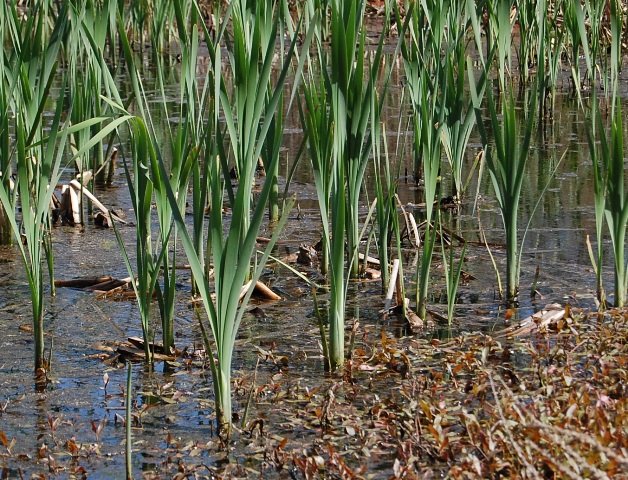
I’ve been hearing the peepers for a few weeks now. But, last night their constant sound was drowned out by a loud trill. At first, I thought it was a car in mechanical failure. But, as it never let up and, as it seemed to emanate from the pond, I concluded it must be frogs. Since I had yet to see any, I thought I might be wrong in this guess. But, today, I saw many frogs at the pond and the sound continues, though less loud. Also, it stops if I approach the edge of the pond from which it is coming. (The frog sits in muck close to the center of the photo above. Click on photos to enlarge.)
Can someone tell me – where have the frogs been all winter? And, the fish for that matter? I just can’t fathom that they survive the frigid winter. And, where have the frogs been for the past few weeks? Or, have I not been observant? I have looked for them. Perhaps their peering eyes are not the first sign of their resurfacing. What did I miss? – because today, I saw at least three, plain as day.
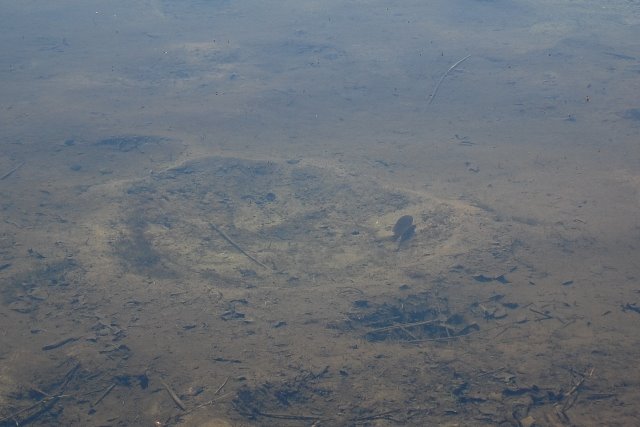 As the frogs warbled their (mating?) call, the fish showed the first signs of settling over their nests. This is one of my favorite sights at the pond – it’s so homey. Momma fish hang in suspension over a round dug-out, which they periodically tidy-up, pushing debris aside. (I say ‘Momma’ fish, but they could be ‘Daddy’ fish for all I know. A visit to my post about ‘craters’ will tell you that I learn as I go in my observations. I had originally thought the nests were craters formed by natural springs on the floor of the pond. Observe and learn – and listen to lessons of the occasional fisherman at the pond – is my scientific method!)

 SilverLining