
During the winter months, I had less access to the pond. After a snowfall, it might be a while before the path was cleared by a sidewalk plow or tromped upon by snowshoe or boot. But, there were days I could traverse whatever the terrain winter availed to me. I found that on these walks there were some things specific and some things vague that conjured memories from my childhood.
One thing specific sat frozen in the ice one day. Standing out in the dreary white, gray, and black of its surroundings, a bright orange skate guard lay on its side, frozen on the pond surface. I stopped and stared, as its image caused a flood of recollections from my youth.
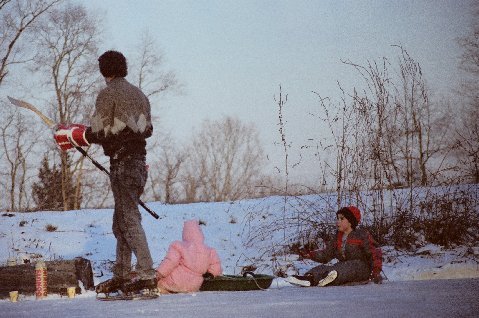 I grew up not 300 yards from a small pond, and in my earliest years, I stepped into the rhythms of activity between my siblings and ‘the pond.’ As we learned to walk, so we learned to skate. In winter there was a well worn trail to the banks of the pond. We spent hours shoveling and skating, making pathways and snow angels, under sunny sky and moonlit sky. Great amounts of energy went toward the clearing of the ice for the pleasure of skating upon it, which we did, forever, in a day.
We’d return to the house and over hot chocolate chatter about the nuances of our play – whose slap-shot was killer, who cried, who careened into whom, whose lace broke, who got hit by a puck and where, who got the worst of the whip. (The whip: Locking hands, we’d form a line and, with a strong skater in the lead, we’d pull each other along at an ever increasing rate of speed. Like a whip, the tail end of our train would snap around, eventually breaking off as hands could no longer hold together. The velocity of the piece broken off, which could be one person or more, would propel it into danger such as open water along a strip of shore, or harm, like a branch, icy snowbank, or lone skater. To youngsters, this was thrilling!)
The warmer seasons were about tadpoles and frogs, worms and fishing, and who ‘fell in.’ The day I fell in came in early spring, when an ‘iceberg’ was still afloat, running nearly the length of the pond (about a hundred feet). My next older brother and I wondered if we could move the ice. Getting long thick branches from the surrounding woods, we leaned upon them with full might at one end, while the other end pushed upon the ice. The ice moved, ever so slowly. In our enthusiasm, my pushing pole broke under my strain, and in I went to the frigid water, which lay between the shore and the iceberg. I remember splashing in, and being stunned by the cold as my head submerged and I instinctively suppressed a gasp. Next thing I knew, I was grabbing at the mud and dead growth along the shore, with my brother on his belly, reaching to pull me out.
Throughout my childhood, the pond was an ever present thread through the fabric of our daily lives. The image of the skate guard brought to mind, not just memories, but the patterned actions that were automatic motions of those years. For those who have ever used a spring controlled skate guard, the dexterous technique to attach the guard to the blade of a skate, remains in the cache of neuropathway blueprints that include, how to ride a bike, how to swim, and how to throw a ball.
 SilverLining