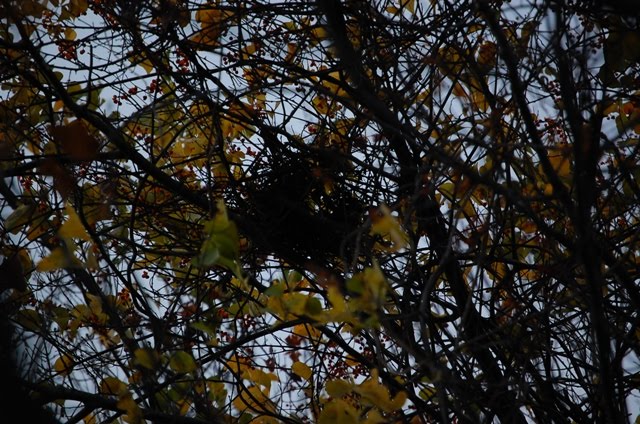
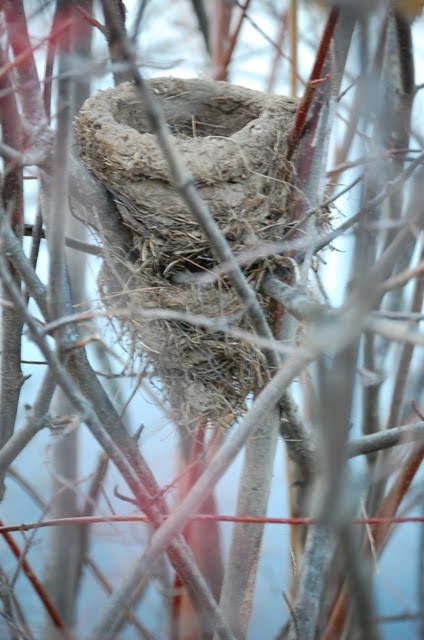
 Nearly all the leaves are down now. The stark look and cold feeling of winter is coming on. Through the bare branches of the trees, birds’ nests are visible in random spots all around the pond. It is amazing to see the sizes, shapes, architectural design, and materials of the nests. Above is a photo of what I call the Guggenheim Museum (a Frank Lloyd Wright design) nest, as seen from 5th Avenue. Below is the E 89th Street side. I can’t imagine the amount of work that went into this solidly built, clay nest. About six inches (or stories) tall, it is donuts of mud stacked upon each other.
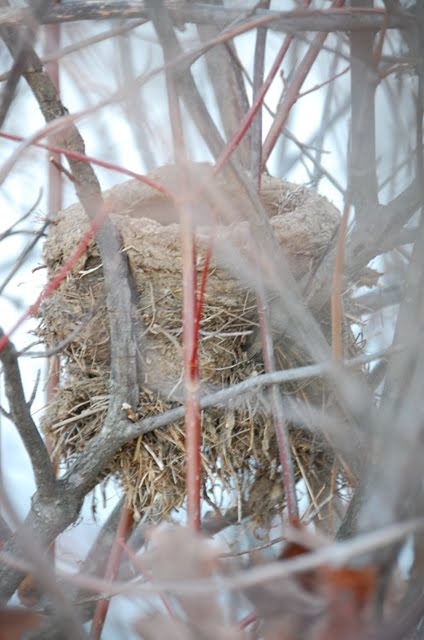 Unlike the Guggenheim Museum, an interior view of this nest is free.
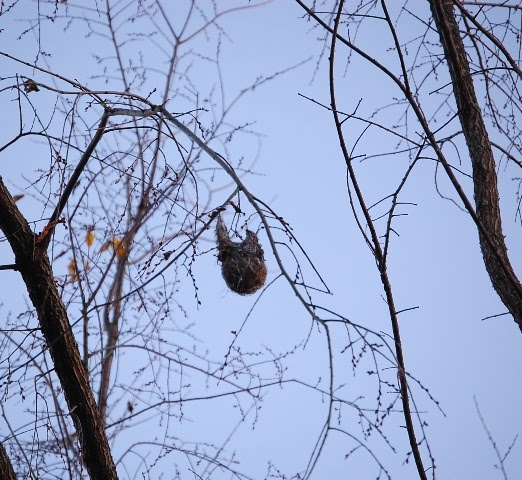
 The Baltimore oriole nest from which the dear little fledgling nervously departed is below, in bare contrast to the cover of green leaves in which it was hatched and grew.
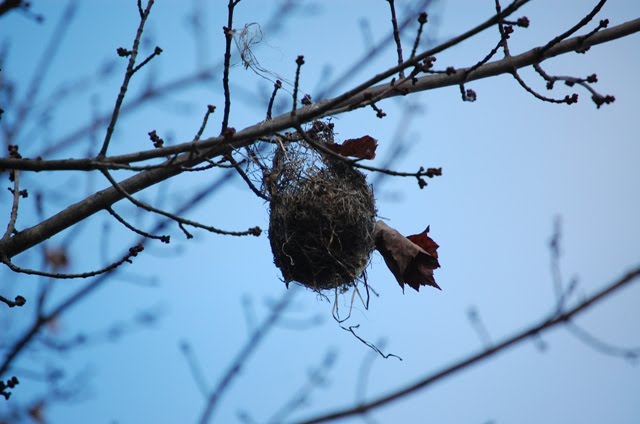 Farther along the path, at the far end of the pond, is a second oriole nest — the distinctive, dangling cradle that gives the appearance of hanging tenuously though I’ve seen it weather strong winds and pelting rain, going completely horizontal with the hatchlings inside!
 This next nest makes me question that we question the intelligence of birds. There is some serious knot tying evident in this structure, as there is in the orioles’ nests’ points-of-contact with the branches.
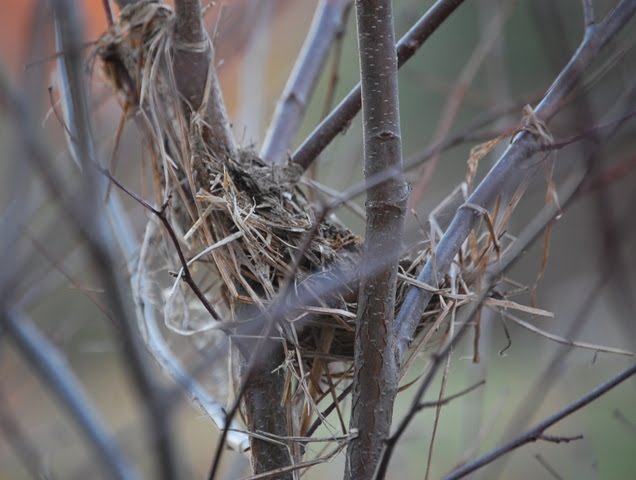 The close-up below shows a wrapping/tying technique.
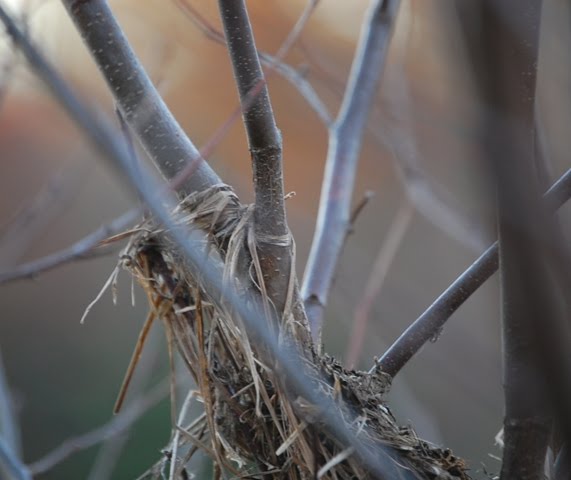 This next nest I call the “junk art” nest. It has bits of curly tendrils (from bittersweet vine, I think) as well as strips of plastic (lower left) as well as randomly sized out-shoots – for better protection, I wonder?
 And the nest below is the “less is more” nest. I believe this is a catbird’s nest. It is located exactly where I often saw the catbird.
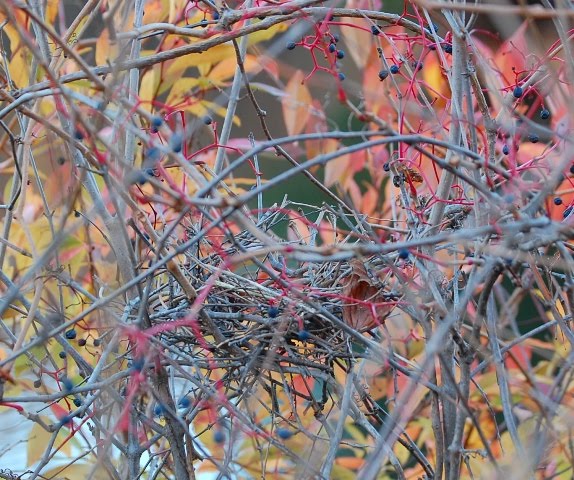 This final nest is the “debris” nest. I’m going to give the former inhabitants the benefit of the doubt and allow that an inordinate amount of leaves landed in their home…not that they were neglectful of nestwork. After all, my nest can look like this after a busy week of us not having time to pick up after ourselves.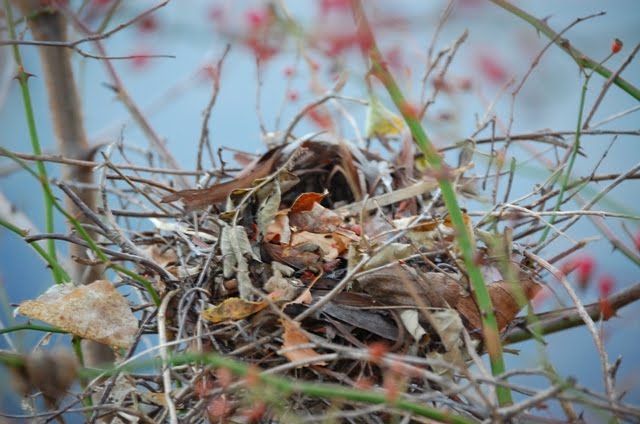
Most of the images in this post were shot from three to four feet away because of lots and lots of branch interference. I contemplate the “thought” that went into picking the perfectly sheltered location of each of these nests. And I think of the parent birds determining on which branches to fasten the structures – for maximum stability through wind and rain, and maximum shelter from other preying animals. And I think about how they are fastened to the branches.
To my mind, instinct is two dimensional and reactive by nature. These nests are three dimensional and required an intelligence that I propose is something a bit more than instinct, if somewhat shy of actual intelligence.

 SilverLining