Harsh Realities

At the start of this month, I announced the arrival of five Mallard ducklings. (See my July 6 post.) I have not written about them since – for two reasons. First, within 48 hours of first seeing them, their count was at four. I just didn’t have the heart to break the news to my readers. Second, my sightings of the family do not occur often, so there was nothing to report. And, each day I didn’t see them I was glad, as it meant the mother was keeping them well hidden. I did wonder where they were, however.

Then one day, I accidentally frightened them from their hideout. I had moved close to the shore at one end of the pond to take a picture of a flower, and with much commotion the mother and her four babies scurried from the reeds and paddled away from me. No sooner had they hit the water, when there was much splashing. A turtle had snapped at them and they all scattered. My heart sank. But, I was relieved to observe the ducklings scurry back to their mother’s side, and cluster around her – like little magnetic bumper cars – as she brought them to safety.

I have stayed away from that area since. But, one day early this week, I did see the now even smaller family – three offspring – in the same section of reeds. Here’s how they are looking. I watched them for half an hour, hoping to see a fourth duckling, but no such luck.

Today, late in the afternoon, the Heron arrived. It landed about twenty yards from the place where I had seen the ducks. For fifteen or more minutes, it crept, step by step, nearer and nearer to the area where I’m sure the Mallard family hides.

I shot several pictures of the Heron and moved closer more than once for a better view. While I contemplated actively scaring it off, to my relief, it decided my presence was enough of a deterrent and it flew off.

While I’d been wondering if the turtles were snatching the babies, a neighbor suggested it was the Heron. I think my neighbor is right.

Love Is In Bloom

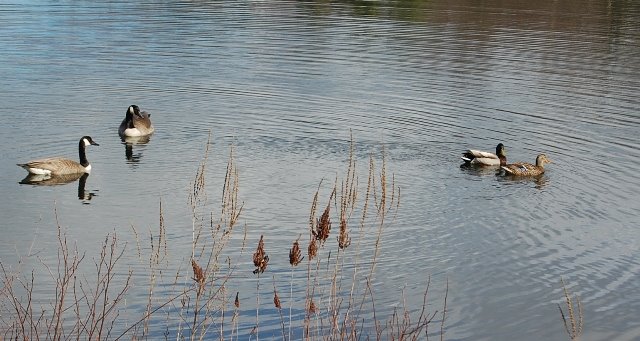
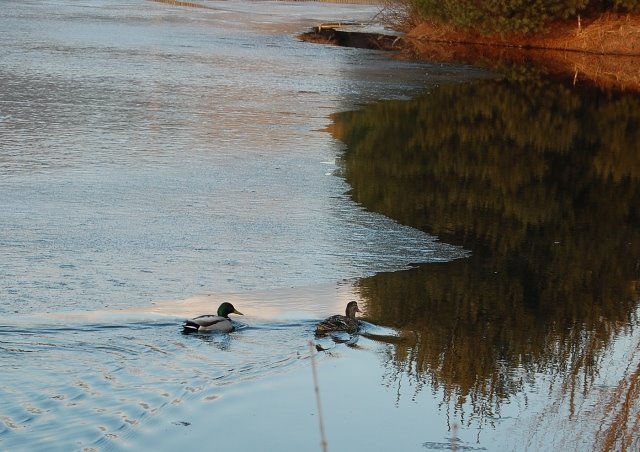
Along with the blossoming of buds, I have enjoyed observing the blossom of love in the waterbirds. Before the ice had melted from the pond, a pair of Mallards floated harmoniously in the chilly water. Soon after, the Canada Geese arrived. Side by side, the pairs of birds shared the warmth of the spring sun. (Click on these photos for enlargement and clearing viewing. Use the back-arrow to return to the post.)


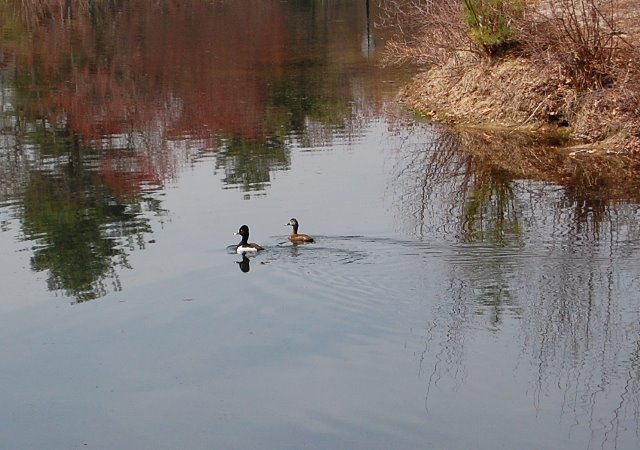
One day, the most delightful tw
o-some, Ring-necked Ducks (below), appeared. These petite birds sat low in the water and stayed close to each other’s side. Often they would take shelter under an overhang of evergreen branches at one end of the island. I have loved watching them and what I see as devotion to each other. As they are small waterbirds, they struck me as delicate and vulnerable. I perceived their physical closeness to be a protective instinct for each other.

If you wonder how it is that I am using the birds’ names in this post, it is that I have become intrigued by the waterbirds as well as the perching birds in and around the pond. My curiosity about them has led me to purchase a pocket guide to help me differentiate these beautiful creatures.

While the other waterbirds were used to me and allowed me to get fairly close for photos, the Ring-necked Ducks were exceedingly timid and in smooth but determined motion, would paddle a distance from me if I approached their location while I walked the perimeter of the pond.


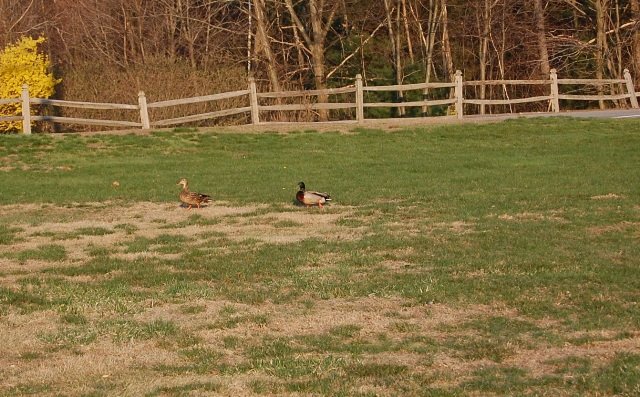
Last week, I began to see the male Mallard alone in the pond. I noticed that he would trail the Ring-necked Ducks. I supposed he was lonely. In the early evening the female Mallard would come by the pond and together they would go for a quick fly-over or a stroll on the shore. In this photo I imagined him to be Mr. Darcy to her Miss Elizabeth Bennett – as he pursues her with determination, as she keeps a cautious distance. (Click on photo to enlarge.)

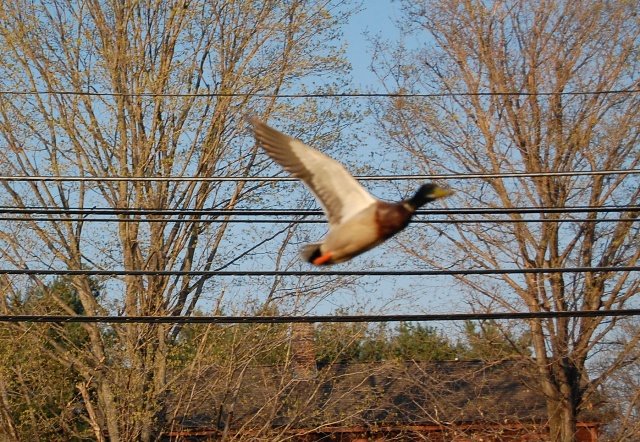
I think she has taken up residence across the street in a stream setting, perhaps tending to a nest. He chases her to the street but then flies back to the pond alone. Here, he buzzes just over my head in his return flight to the pond.

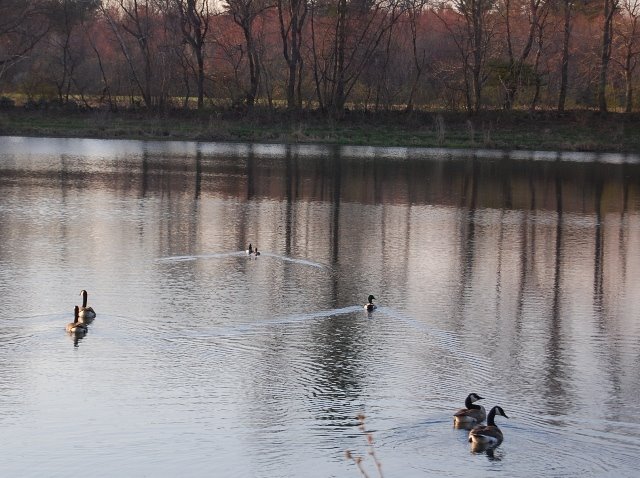
Each day now, as evening settles, the pairs dreamily float along. In this final shot, I will identify the waterbirds in the characters of Jane Austen’s Pride and Prejudice – for the enjoyment of those of you who love her story of love and pairings as much as I. So, pictured here, I see Miss Jane Bennet and Mr. Bingley (the Ring-necked Ducks) in the lead, with lonely Mr. Darcy (the male Mallard) trailing next, looking about for Elizabeth. The Bennet parents and their in-laws, Mr. and Mrs. Gardiner (Canada Geese pairs), follow as they keep the young love birds under their watchful eyes!