A New Ball Game

When I wrote yesterday’s post, I knew I had a telephoto lens on order. But, I didn’t mention it, as I thought I had several days before it arrived. But today, just as I was deciding to take a break from my work and head out to the pond for a walk, a UPS truck arrived with my lens. I have mixed emotions about this. It’s been a challenge taking pictures with the wide-angle lens. It’s fine for the overall scenery, but trying to capture the nuances of variation in the creatures has been difficult. Still, I think it’s been great training for me.

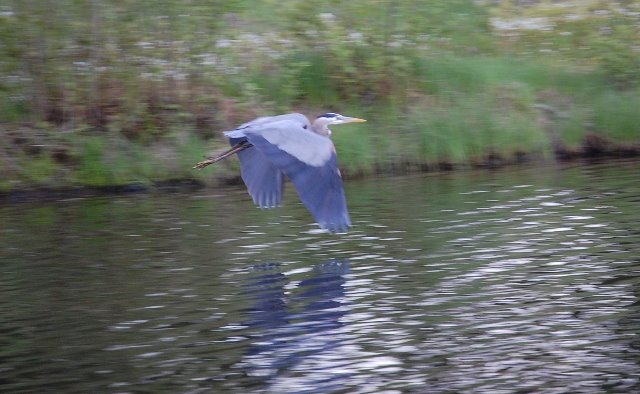
So, with some ambivalence, I put the new lens on my camera and headed out the door. As if not by a twist of fate, what arrived on my heels was the Blue Heron. I’ve seen this waterbird only once before this spring. Despite standing for more than an hour observing it late this afternoon, I’m not fully satisfied with the pictures (one is above) that I took today with my new lens. It isn’t as crisp as I had hoped. But, no matter, as my time keeping the Heron in the narrow range of my new viewfinder reaped a shot so unusual at the pond, it’s as if it came with the lens itself.

While I watched the Heron though the lens, a furry four-legged animal walked not eight feet from where the Heron stood. Now, I’ve described the Heron in past post. It’s a bold bird. It didn’t flinch as the thing passed by it. So brazen is this bird that it left its watch along the shoreline, where it had spent thirty minutes stalking fish, and walked up the bank to assess what had encroached on its turf. At first, I thought it was a dog. But, as no leash and person followed it, I raised my eyes from the camera to assist determining what it was, by putting it in fuller context. I was across the pond, so it was not until I returned home and looked at the pictures that I could see that it is a Red Fox. You’ll need to click on the photo to see it well. Return to the post using your back arrow.
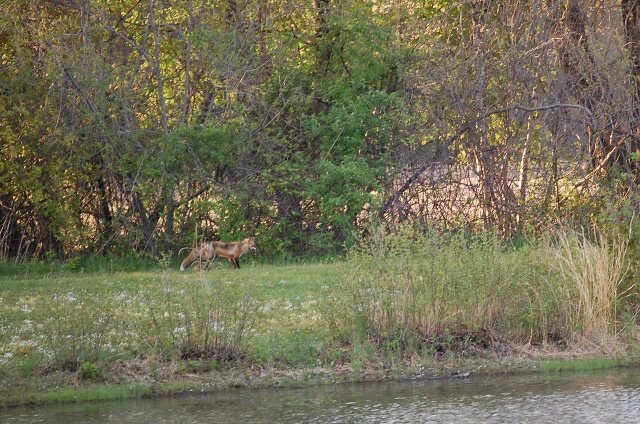
(When you click on the photo below to enlarge it, look closely behind the shrub on the left. You’ll see the Red Fox about to walk by the Heron as the bird calmly continues to watch the water.)
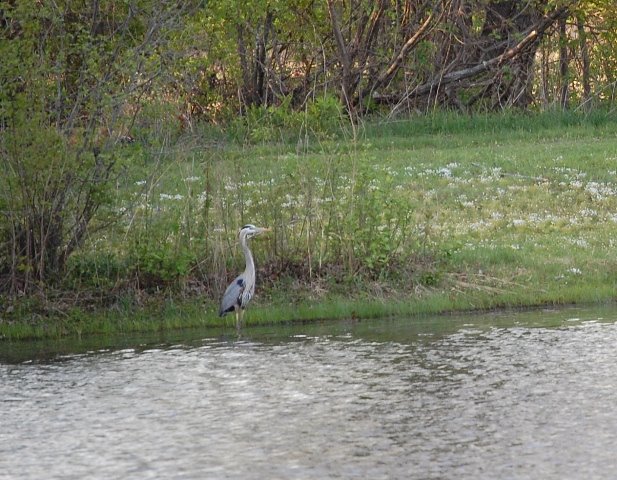
Below is the Heron, up the bank, watching the Fox.

So, day one, the lens made a huge difference. It would have been frustrating to not be sure what it was that I saw and to have photos that didn’t quite make it clear.

So that you can share my enthusiasm for the power of this new lens, here are other pictures I took today. The first shows a Greater Yellowlegs, which I saw for the first time two days ago but was not able to get the detail that this picture shows.
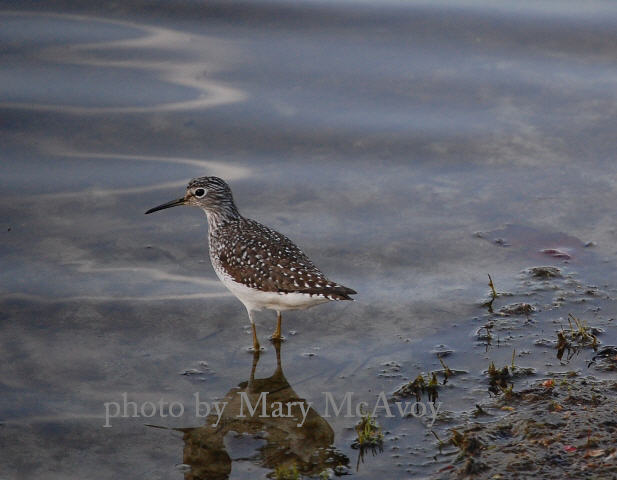
This waterbird, which is only about five inches long, has a remarkable wingspan of perhaps fifteen inches. (The photo below was taken with the wide-angle lens a couple of days ago.)

The ordinary American Robin is not looking so ordinary to me lately. This bird has delicate white markings on its tail when it’s spread for flight. As this photo shows, its color tones complement its natural habitat.


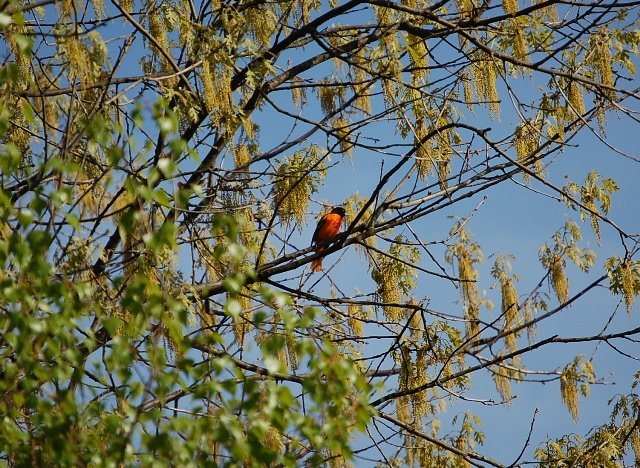
I must admit I’m quite happy to finally do justice to the colors of a Baltimore Oriole. This bird has the most striking orange, much brighter than the Robin, and the black is utterly black.
And, below is an up close and personal shot of the Song Sparrow, showing clearly its breast mark. Again, click on the photo to enlarge for best viewing.
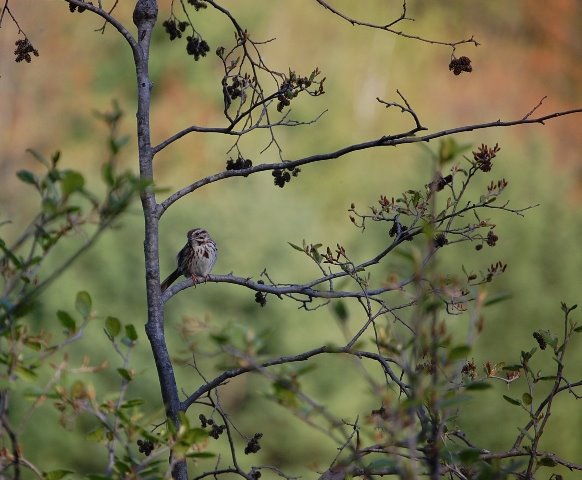
I think I’ll try to note, by use of WA (wide-angle) and TP (tele-photo), which lens I use for future photos to this post. It’s not going to be the same. I suppose the viewing will be more interesting for readers. But, it seems a bit too easy to me to get such quality close-up shots!

Bird Whisperer


I don’t recall exactly when it began. I seem to remember being mesmerized by a yellow bird in the stark branches of a shrub in early spring. Raising my camera to take a picture, I was sure my lens strength wouldn’t bring about a quality photo. And, although I could see the bird in the picture when I looked at it while at my computer later in the day, I knew the photo wouldn’t thrill anyone else as the bird was barely discernible.


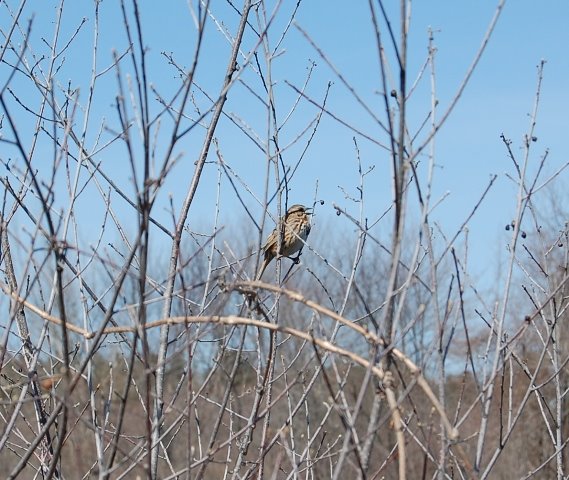
The vocal outpouring of a Song Sparrow stopped me one day and, for the first time, I achieved a picture in which a bird would be visible to any viewer. Because I don’t yet have a telephoto lens, this was no small feat.

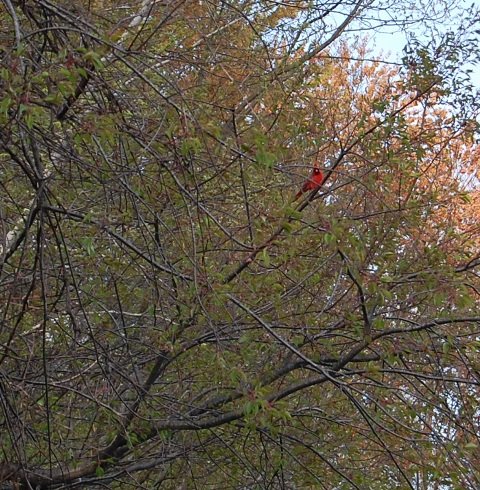
It might have been a male Cardinal next – a flicker of red distracting me from the pond.

Then came a glimpse, with the naked eye and the eye of my camera, of a bird with a fleck of red on its wings. That was what did it – and, by ‘it’, I mean that’s what turned me into a bird watcher. And, I was thrilled that my camera saw what I saw, even though the photo was not well focused.

When I began this blog, I said I would just record what I observed. I did next to no research on any of the living things I wrote about. But, the birds have brought out the serious scientist in me and I find myself wanting to identify and catalog them. So, I bought a simple pocket guide of New England birds. I knew that with this act, I was redefining my pond observation, at least of the feathered creatures.

To date, I have used one lens on my camera. The numbers on it range from 18 to 55. The wording of the prior sentence reveals the level of understanding I have of cameras. I do know the lens is considered ‘wide-angle’, which means that it takes pictures that capture a wide visual range when set at 18. Rotating the lens closer to the 55 brings the subject nearer in the shot. But, even when set at 55, the camera does not get a close-up pictur
e of a bird with any level of detail. So, taking pictures of birds has been a challenge.

But, during the last few weeks, I find that I have achieved ‘a way’ with the birds. I realized early on that if I was too excited when spying a captivating bird, my picture was awful because my demeanor was not peacefu
l. In my excitement, I was moving and, so too, was the camera, and perhaps, as well, the bird.

The first time I captured a really good ‘wing and a prayer’ shot – that is, a picture that surprised me by its clarity, since it was taken in tremendous haste and with what seemed to be, no planning – I realized, as I thought about it later, that I had remained perfectly calm. I’ve tried to repeat that posture since, with some luck.

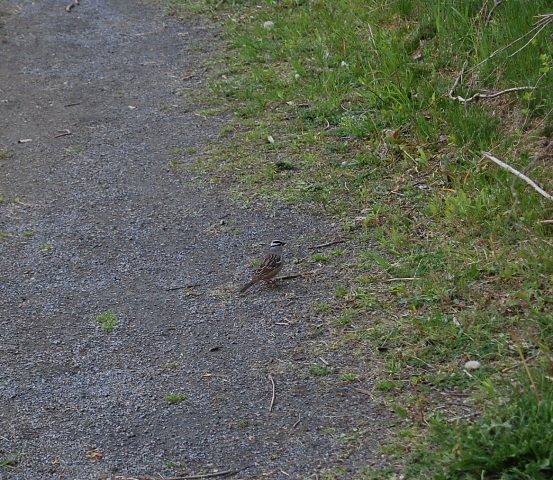
Most interesting though, is that the birds seem to respond to my calmness. They allow me to come closer. I have written about this with the blue heron – how she seemed to adapt to me and let me get within ten feet of her by the end of last summer season – after we started the season forty or more feet apart, consistently. And, now, with the smaller birds, I am aware of their greater tolerance of me. I believe this is because I remain peaceful. This may sound a bit crazy, but I think it’s true. For instance, this Black and White Warbler (?) has hopped in front of me along the same stretch of pathway three times now. Each time, as I walk calmly toward it, it allows me to get closer.

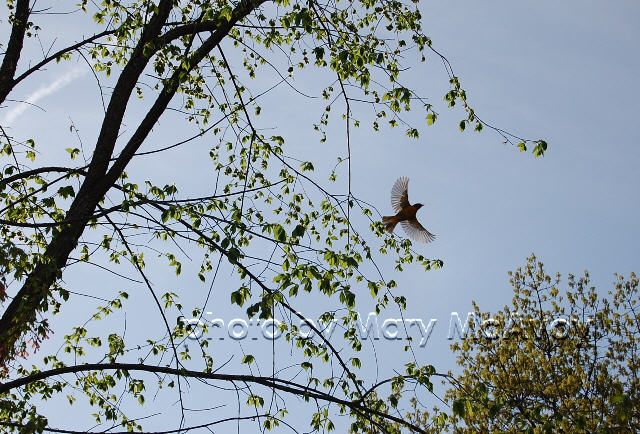
Throughout this post, I’ve used samples of pictures I’ve taken during the last three weeks. The one that appears at the beginning of this post is, I believe, a Baltimore Oriole. It was a predominantly orange bird for sure. I had been taking its picture while walking slowly toward it. When I reached its tolerance of my proximity, it flew from the branch on which it had been. It’s my habit to keep shooting when a bird takes flight. I didn’t realize in the moment what the camera had captured. I was thrilled when I saw the picture. (As always, click on the photos in the post to see an enlargement. Use the back arrow to return to the post.)

I’ll be writing again about the birds at the pond.