

Generally, as I approach the pond I begin to scan it with my eyes, looking for any obvious visual point of interest that might be the subject of my photo taking. If nothing readily presents, then I keep an eye peeled for more subtle presentations. It is in that closer look that I sometimes spy the Great Blue Heron. It blends with its surroundings beautifully, as you see below:

There are times, such as today, when from a distance, I have to rely on the telephoto view through my camera lens to confirm that what my unaided eye suspects is the Heron, is in fact the predatory bird amidst the reeds. I might snap a few shots, all the while knowing that without a more powerful lens, there won’t be much pizazz in the photos if I upload them to this blog. If I were to crop to a more visible show of the bird, there would be no crispness left in the picture.
Then, I hope that when the bird decides to take off (perhaps as I get too close for its comfort as I walk the path around the pond) I am well positioned, I have no visual obstructions, and I have the camera at the right settings to best capture the flight. You’ll remember, too, from past posts to this blog, that I nearly always have the leash of my dog around my left wrist!
All of what I’ve just described occurred today. And, as the Heron took off, I had obstructed view for my first shot (see here) as I gave the the ‘stay’ command to the dog, hoping it would take in his little brain! It did.
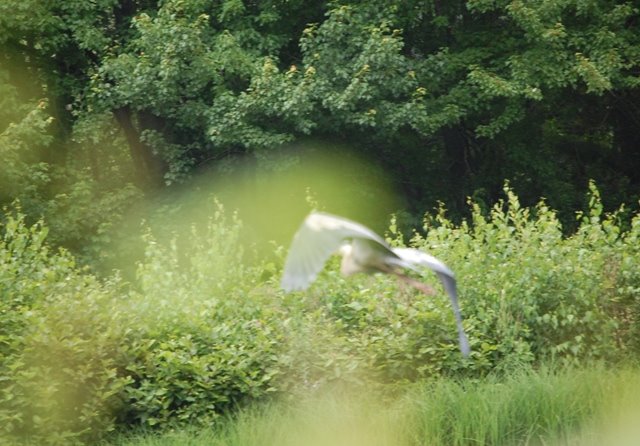
You have to appreciate that the Heron is in motion. So, I have to out-chase it, so to speak, with the lens. Then, I hold steady so that if and when it keeps on my calculated course and passes through the focal point of my camera, I have a chance at a good shot. To date, I’ve done this with perhaps hundreds of pictures of the Heron – with varying degrees of success.
I notice that since I’ve been using the camera to observe birds, my eye/brain connection has perfected what I think of as a freeze-frame phenomena. When I’m driving in my car, for instance, and a bird passes in view, in a portion of a second my eyes lock on it and my brain registers its features. It seems to me that in the past, I barely noticed the passing of a bird – it was a peripheral event, to both my eyes and my mind.
This phenomena also occurs now when I look through the lens. Today, although I took perhaps six shots of the Heron as it flew, when the few seconds had passed and I lowered the camera, I had the sense that a freeze-frame image had been caught, not just in my mind but by the camera.
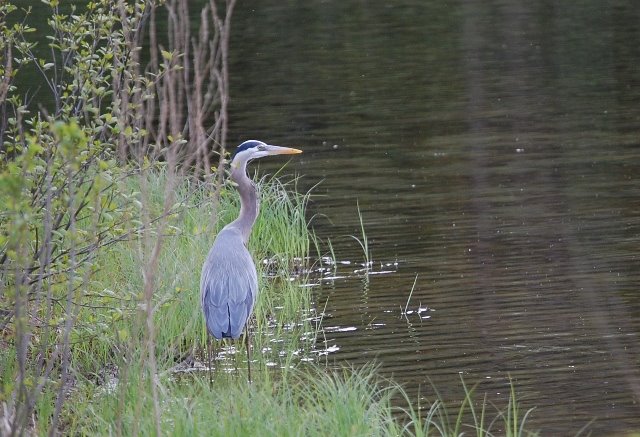
With some excitement, I downloaded the shots as soon as I returned to the house. The picture at the top of this post is the one that had stuck in my mind. It has all the elements I look for – the bird in its natural habitat, the habitat and bird (especially) in focus, a keen display of wings, and the show of its body in its flight posture. The Heron, it is to be noted, tucks its head toward its body when flying (unlike Canada Geese, which fly with their necks elongated). You can appreciate this by comparing the photo at the top of this post with the photo here, which displays the length of its neck, as it stands at the shore.
I don’t expect that what pleases my eye will always be a photo that strikes my blog viewers in the same way. And today, I just hope you get some enjoyment from the photo. I, personally, love it, and consider it an achievement in my photography skills!
(As always, click on the photos for better viewing. Use your back arrow to return to the post.)
 SilverLining