
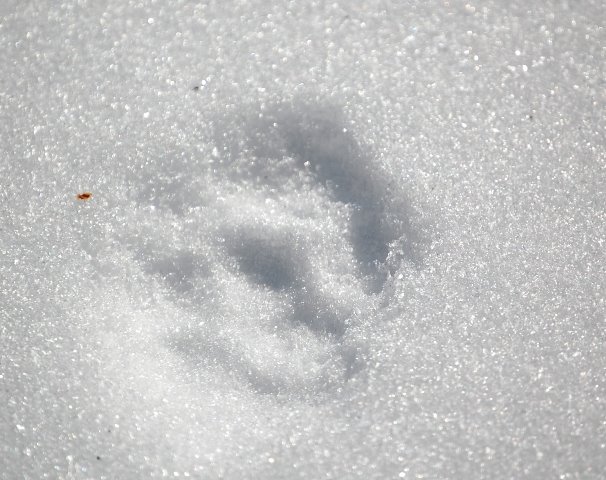
One day mid-winter, when the snow was fresh, tracks were apparent around and across the pond. I was struck by the idea that in other times and still, in other places, the presence of animal tracks meant and means a great deal – especially to the hunter providing for a family. To me, they were interesting patterns and thought provoking trails.
For instance, I wondered what charm school taught this four-legged creature to gingerly place one foot in perfect alignment with the other. A runway model is hard pressed to get her footing so precisely set. (And is it a pair, a couple, that started along this exact path?)
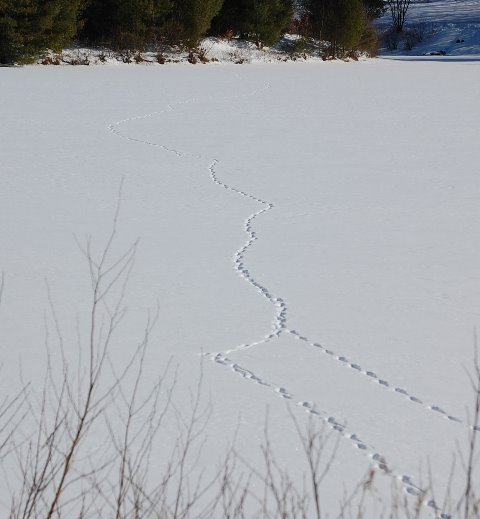
And what accounts for the circuitous route these animals took from the pond’s shore to the island? While each step is exactly set, why is the overall path so wandering – across a wasteland. Can there possibly be a scent in the frigid ice and snow that this animal is following? Is it delirious with hunger?
And of course I wondered, were these the tracks of a deer, a coyote, a fox? That I don’t know this, led to the thought – how far we have separated ourselves from our mother, Earth.
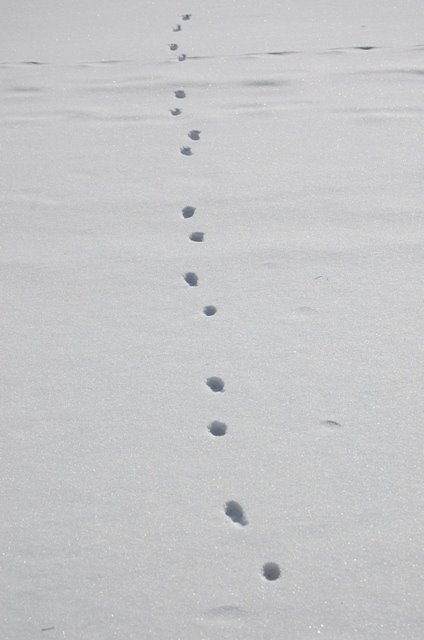
And what sweet little thing made the tracks shown below? And what is its likelihood for survival this season?
I keep a collection of books near my bedside. They are there to inspire when my mind is hungry at the end of a day, or to soothe when sleep is slow to come as my brain is in a spin.
A few nights ago, I chose from this selection of books the ever inspiring to me, Touch the Earth, by T. C. McLuhan. This book was published in 1971 and is a compilation of Native American quotes, and the circumstances under which the words were spoken. Here’s the content of the page I opened to, by chance. They were spoken by Chief Luther Standing Bear who was born in 1868.
“The Lakota was a true naturist – a lover of nature. He loved the earth and all things of the earth, the attachment growing with age. The old people came to literally love the soil and they sat or reclined on the ground with a feeling of being close to a mothering power. It was good for the skin to touch the earth and the old people liked to remove their moccasins and walk with bare feet on the sacred earth. Their tipis were built upon the earth and their altars were made of earth. The birds that flew in the air came to rest upon the earth and it was the final abiding place of all things that lived and grew. The soil was soothing, strengthening, cleansing and healing.
That is why the old Indian still sits upon the earth instead of propping himself up and away from its life-giving forces. For him, to sit or lie upon the ground is to be able to think more deeply and to feel more keenly; he can see more clearly into the mysteries of life and come closer in kinship to other lives about him…
Kinship with all creatures of the earth, sky and water was a real and active principle. For the animal and bird world there existed a brotherly feeling that kept the Lakota safe among them and so close did some of the Lakotas come to their feathered and furred friends that in true brotherhood they spoke a common tongue.
The old Lakota was wise. He knew that man’s heart away from nature becomes hard; he knew that lack of respect for growing, living things soon led to lack of respect for humans too. So he kept his youth close to its softening influence.”
 SilverLining
I enjoyed every picture and every word – and when this darned snow storm leaves us and the ground shows again I just might go and sit (if I can get down)on mother earth and rejoice (if I can get up).
LikeLike