
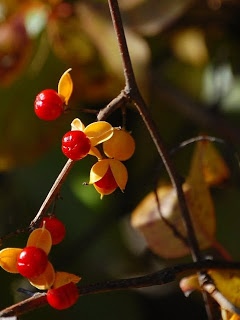
 Bittersweet is so pretty. That’s a simple truth. The deep red berries framed by their rich yellow peeling are beautiful adorning the outdoors or as a decorative accent within an interior setting. Enjoy these images I’ve taken of bittersweet that borders the pond.
Because of its beauty, I struggle with the truth about this plant – it is choking to death many of our trees. Bittersweet is not native to this country and it has no natural predator. Environmentalists ask that we eradicate its wild growth by cutting the vines, and by only growing it in contained pots. And that, whenever we use it decoratively, we dispose of the decoration in a bag, to contain the berries. 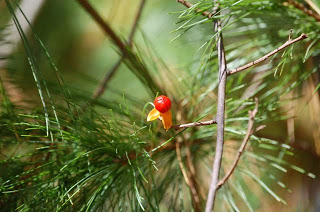
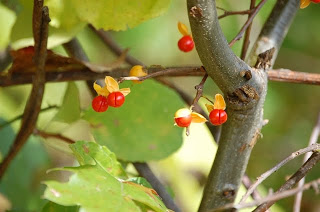 Recently, on road trips, I’ve noticed that along the highways (through the eastern states anyway), vast stretches of trees have been pulled to the ground by this vine.
At the pond, this destruction is very evident at this time of year when there are no leaves on the trees. Entwined with the bittersweet are both poison ivy and Concord grape vines. There is a real battle going on along the far side of the pond – and the trees are losing.
Even in its wrath, the vines are artistically beautiful, fluid and graceful.
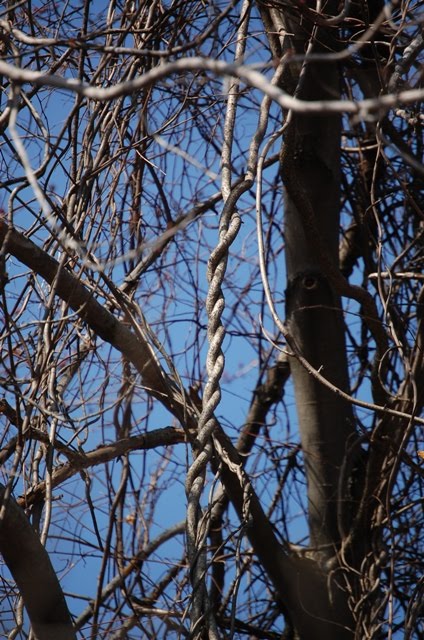
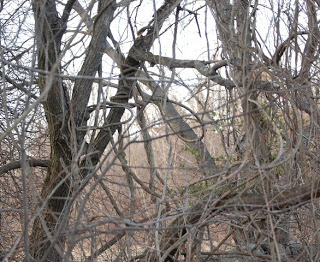 But the mass of their weave, as shown below, indicates how out of control and overpowering this plant has become.
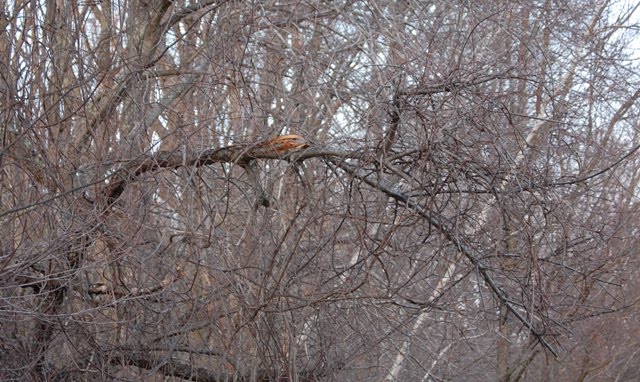
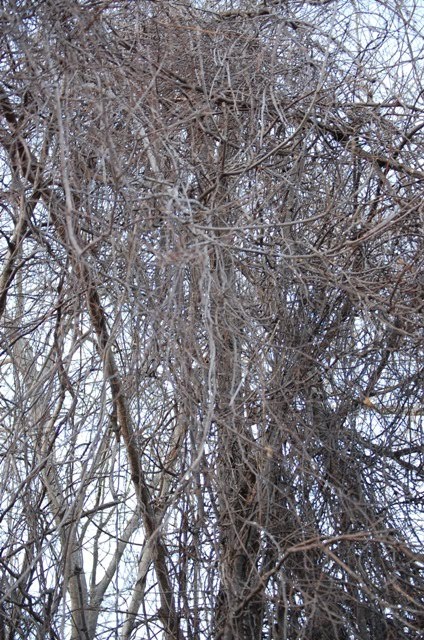 The destruction is evident in the pictures below of trees broken and bent by the pull of the vines. What appears as a photo of birch trees that I’ve neglected to rotate 90 degrees counter-clockwise, is truly the trees bent to that angle by the tug of the vines.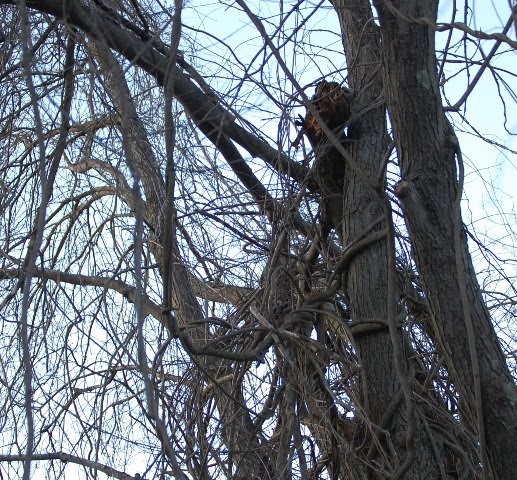
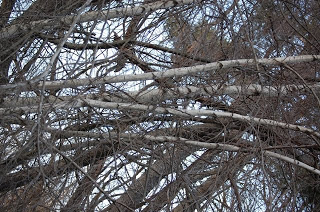 And you can see, too, the break in branches, the final give when the limb can no longer hold.
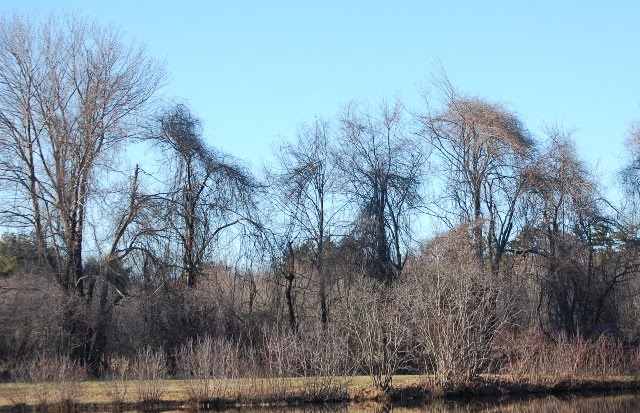
  When looking across the pond to its far side, the stunted growth of the trees is evident in the tree-top line.The closest view below looks to me to be not unlike a Tim Burton creation – something eerily close to reality, but distorted by a sinister force.
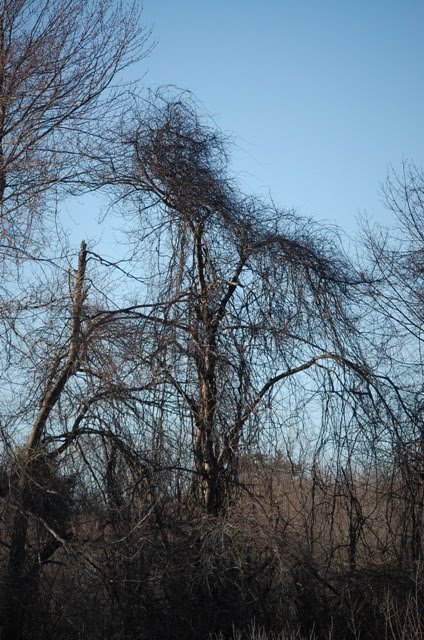 See the graceful sweep of the invasive plant as it reaches from one tree top to another in its unstoppable intent to reach for the sun’s light and warmth for its continued sustenance.
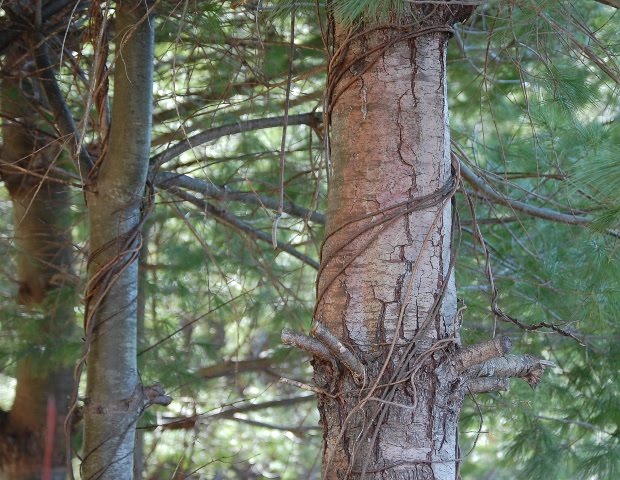
 The sturdy pines appear to hold up better. But I’ve seen the vines, with no urgency of time, cut deep into the trunk of a tree over the span of years.
  Again, here’s the pretty predator:
 SilverLining
Absolutely beautiful photos! Thanks for sharing them with us… Where to you find the time?!? 🙂
LikeLike
Thanks for your comment and thanks for visiting SilverLining! I wish I had more time for this blog! It's taken me more than three years to assemble the posts and photos here. Most was done in the first two years. I just don't seem to have enough time to add to it as often as I'd like. Thanks again – Mary
LikeLike
Thanks for sharing your beautiful photos. I'm glad I read this post, as I had been planning to plant some Bittersweet on our property, but didn't realize it could be so destructive.
LikeLike
I'm glad you found the post before planting your Bittersweet. Consider planting it in a container with a small trellis for it to climb on. Bag trimmings so the berries don't reseed. Thanks for visiting my site. Mary
LikeLike
Really nice pictures and posts. I didnt even realize we had such natural wealth all around here but reading your blog and seeing the pictures makes a difference. Sud Kaushik
LikeLike
I'm so glad you visited my blog! I hope it enhances your walks – to just know what sorts of things you can be watching for. Thanks – Mary
LikeLike
Thanks for sharing this information. The berries are beautiful. Too bad they are a marker for such destruction.We've been out scouting sites for photographing wildflowers next year and have seen vines with red berries that are unfamiliar. They aren't destroying plants but it looks like we're at the edge of its range in Georgia. We'll have to examine them more closely.
LikeLike
Excellent post. I appreciate the graphic illustrations of the incredible damage this bittersweet, the Asian bittersweet(Celastrus orbiculatus), can do. It's interesting that the other bittersweet vine found in the US, the European bittersweet (Solanum dulcamara) is also invasive. I wonder whether it is equally destructive.Thanks for your wonderful photos and remarks.
LikeLike
The photos of the bare vines are really interesting. I have to put in a good word though for American Bittersweet (C. scandens). Probably not a plant for a specimen tree in the suburbs, but it has its place in a woodland. More about bittersweet.
LikeLike
Hi Anne,Thanks for visiting SilverLining and thanks for sharing more info on Bittersweet. Your post (link above in Anne's comment) adds more to think about. I was driving along a highway here in New England last weekend and I kept seeing patches of trees brought down by a destructive vine. I wondered if it were Bittersweet, and if so, Asian or American. And thanks for the reminder about the poisonous aspect to the berries! The only time I had to use ipecac in my parenting was when one of my children left a trail of chewed red berries (yes, Bittersweet from an interior decoration!) through the livingroom! The ipecac worked and all was well! Thanks again for you visit and informative comment and link. Mary
LikeLike