 Today, I saw many birds on a wire that runs along the street that’s about two hundred feet from the far end of the pond. I thought it was a small flock passing through town.
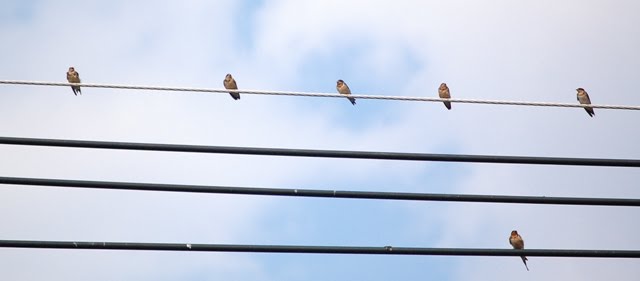 But as I watched and took photos, I began to see and hear familiar sounds. I had thought the season of nesting and baby birds had ended. But as I watched this line-up on the wire I began to realize they were all fledglings. And the parents were busily feeding them still. It wasn’t till I was home and able to view the photos on my computer that I could identify them as Barn Swallows.
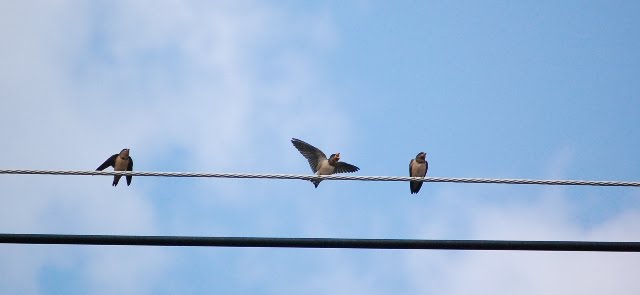 Above, a hungry young is vying for attention. And below, parents fly in, ready to position themselves for feedings.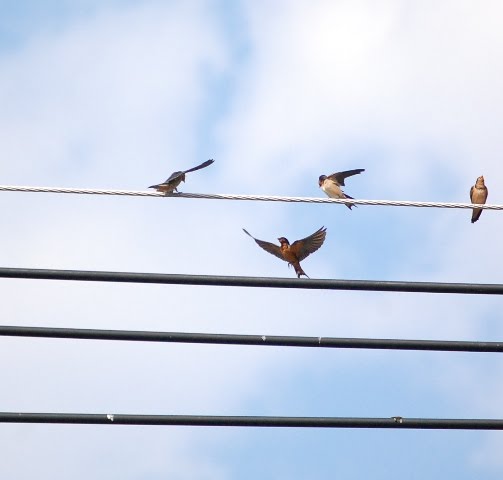
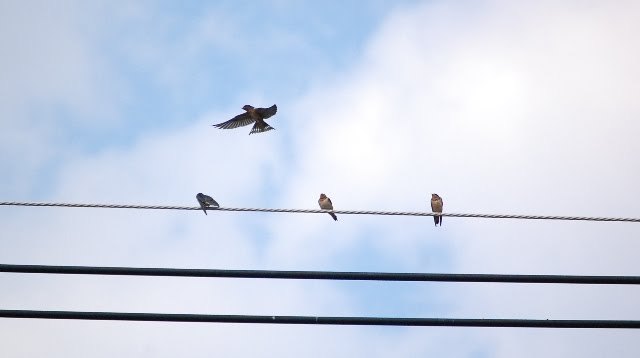 I can’t determine how the parent decides which bird gets the food. Below, two of the young show their hunger with beaks open.
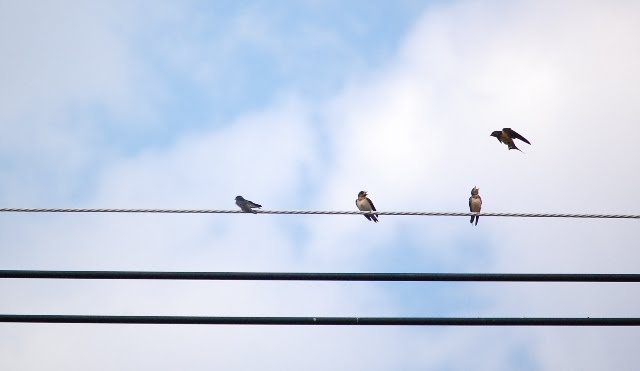 At one point, about four of the birds flew off with one of the adults (image below.) Four others remained on the wire. I have no idea how young birds know who is to go for a trial flight and who is to stay put. But I do know that there is a system of behaviors – sound and motion signals – that dictates these activities, and it’s the parent who makes the call, so to speak.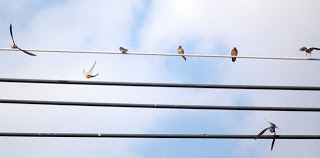
 What you won’t see is how this scene ended. In the blink of an eye, the final four birds abruptly and simultaneously flew from the wire – without the accompaniment of a parent. I know – not only from what I’d seen already from these birds, but from observing the Red-winged Blackbird – that a parent escorts a group of young.
I was puzzled by this sudden and unexpected flight. So surprised in fact, that I brought the camera down from my eye, and audibly said, “What?” I was really puzzled. I found myself looking around – for the birds, or for meaning in their departure. About forty feet to my left, was the frightening answer. A Red-tailed Hawk was swooping in, having just come over the treeline. I was stunned. It was not more than thirty feet from where the birds had been. By the time I got my camera back up to my eye and was focusing, it had turned back and was just dropping behind the trees, as you can see in this zoomed-in grainy image. The predatory bird is just to the left of the treeline, midway down the image. 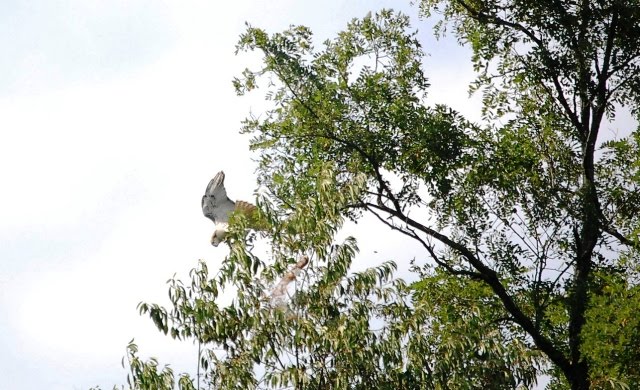 It was a treat to upload these images and to see the detail of the activities that had occurred in less than five minutes time.
Birds on a Wire


Mary, I have been reading your blog with so much pleasure. Your pictures are outstanding. Your writing is inspirational. As of August 24 your site is the Nature Site of the Week at Nature Center Magazine.Emma Springfield
LikeLike
Hi Emma, I've just visited Nature Center Magazine and I am so pleased that SilverLining will be your Nature Site of the week this week. What a wonderful place you've created for sharing around-the-world nature! I've added NCM to my favorites. Thanks for visiting SilverLining, thanks for the exposure through Nature Center Magazine, and please visit often! Mary
LikeLike
What a charmer of a blog. Your eye for a good photo is spectacular. I really like the oriole shots. I feed them in the spring, but they leave to nest.Your milkweed shots are fun, being close to a pond itis swamp milkweed. Common has a globular umbrel flower and larger leaves.It is a great attracter for a variety of butterflies and insects. I like to chase the herons, I try to get close in a kayak, but they know if they are being threatened. At Padre Island I shot them real close and was amazed of the change in behavior.Congrats for blog of the week in Nature Center. It directed me toward life with a silver lining.
LikeLike
Thanks for visiting SilverLining and thanks for your compliments! I am delighted to be featured at Nature Center! I'll have to study my milkweed better! What grows alongside the pond does attract butterflies – the Monarch especially. Please stop by SilverLining again, Mary
LikeLike
You have a very nice blog. It would be an amazing thing if we would one day learn to understand some of what other animals use as language. It looks like the young swallows were very lucky that they got away in time.
LikeLike
Emma recommended I visit your blog and I am pleased with what I found!Please keep on sharing your wonderful wildlife experiences.
LikeLike
Hi Ratty – Thanks for your visit to SilverLining. There's a book, Indian Boyhood, by Charles Eastman (Native American name, Ohiyesa) in which there is some description of the Native Amercan's ability to understand the communication of the animals. I think we are just not listening, and we've separated ourselves from nature – spending very little time in natural settings. Thanks again for visiting my blog, and come on by again soon! Kind regards, Mary
LikeLike
Hi Jean, I intend to add more to my blog shortly. I saw a huge snake in the water a few days ago and I'm anxious to post pictures and comments. Also, while watching the snake, I caught a glimpse of a bird whose call was unfamiliar. I finally got a photo – not great quality – but I think it's either a red-hooded or red-bellied woodpecker. Wonderful call as it flies. Please visit SilverLining again! Mary
LikeLike